Islam is built on both belief and action. The heart of that action is captured in a well-known hadith in which the Prophet Muhammad ﷺ said, as reported in Sahih al-Bukhari and Sahih Muslim: "Islam is based on (the following) five (principles)" (Sahih al-Bukhari 8, Sahih Muslim 16) — the five pillars below. This page is a practical starting point for learning them. It focuses on the essentials that Muslims broadly agree on; where the schools of law (madhhabs) differ in detail, we note it rather than picking sides.
Every individual obligation on this page, in one pocket book
Belief, purification, the five prayers, fasting, zakat, the major prohibitions, and character — everything classical scholarship places in the fard al-'ayn category, in a 12-page A5 guide.
- What "fardh ain" means, and how it differs from communal obligations
- Correct belief, purification, prayer, and fasting
- What every Muslim must know is haram
- The character obligations that bind everyone
The Five Pillars of Islam
The Five Pillars of Islam: one statement of faith and four acts of worship. 1, Shahada, the testimony of faith, the only pillar that is a statement rather than an act; said once with sincere belief it makes a person a Muslim. 2, Salah, the five daily prayers, performed five times a day facing the Kaaba in Makkah. 3, Zakat, obligatory charity, a yearly 2.5 percent due on wealth that reaches the nisab and is held for a full lunar year. 4, Sawm, fasting in Ramadan from dawn, Fajr, until sunset, Maghrib. 5, Hajj, the pilgrimage to Makkah, obligatory once in a lifetime for every Muslim who is physically and financially able.
The Five PillarsA statement of faith, then four acts of worship that shape the day, the year, and a lifetime.
The testimony of faith — the only pillar that is a statement rather than an act. Said once, with sincere belief, it is what makes a person a Muslim.
The five daily prayers — performed five times a day, facing the Kaaba in Makkah.
Obligatory charity — a yearly due on wealth that reaches the nisab and is held for a full lunar year.
Fasting in Ramadan — from dawn (Fajr) until sunset (Maghrib), abstaining from food, drink, and marital relations.
The pilgrimage to Makkah — obligatory once in a lifetime for every Muslim who is physically and financially able.
These are the framework of a Muslim's practice — a statement of faith, and then four acts of worship that shape the day, the year, and a lifetime.
Shahada
Salah
Zakat
Sawm
Hajj
1 · Shahada — the testimony of faith
The Shahada is the declaration that there is no god but Allah and that Muhammad ﷺ is His Messenger. It is the only pillar that is a statement rather than an act — but saying it once, with sincere belief and understanding, is what makes a person a Muslim. It is then repeated for a lifetime: in the call to prayer (adhan), in the sitting of every prayer (tashahhud), and ideally as one's last words — the Prophet ﷺ said whoever's last words are "there is no god but Allah" will enter Paradise (Sunan Abi Dawud 3116).
أَشْهَدُ أَنْ لَا إِلَٰهَ إِلَّا اللَّهُ وَأَشْهَدُ أَنَّ مُحَمَّدًا رَسُولُ اللَّهِ
Ashhadu an lā ilāha illā Allāh, wa ashhadu anna Muḥammadan rasūlu-llāh.
"I bear witness that there is no god but Allah, and I bear witness that Muhammad is the Messenger of Allah."
The sentence itself has two parts, and both are needed — a negation followed by an affirmation. This is why it is often described as the key to tawheed (the oneness of God): it first clears away every false object of worship, then affirms the one true God, then accepts the guidance He sent through His final Messenger.
"There is no god…" — rejecting every false deity, idol, or object of worship
"…except Allah" — affirming Him alone as worthy of worship
"Muhammad is His Messenger" — accepting his example as the way to live it out
Because it is a matter of the heart as much as the tongue, the Shahada cannot be forced — the Quran states plainly that "there is no compulsion in religion" (2:256). It is offered, understood, and accepted freely.
2 · Salah — the five daily prayers
Salah is the formal prayer performed five times a day, facing the Kaaba in Makkah. It is the first act a person will be asked about on the Day of Judgement (Jami' at-Tirmidhi 413), and the Prophet ﷺ described it as the dividing line between belief and disbelief (Sahih Muslim 82). Prayer punctuates the whole day — from before sunrise to well after dark — keeping the believer's connection to Allah renewed every few hours rather than saved for one day a week. It is obligatory on every adult, sane Muslim; a full step-by-step guide with the Arabic for each movement is below.
Each prayer has a defined window of time set by the sun's position, so the day naturally reorients around worship rather than the other way around. Missing the window doesn't erase the obligation — a missed prayer is made up as soon as remembered — but praying it within its time carries the greater reward.
3 · Zakat — obligatory charity
Zakat is a yearly charity due from Muslims whose wealth reaches a minimum threshold (the nisab, roughly the value of 85g of gold or 595g of silver, or the equivalent in savings, trade goods, and similar assets) and has been held for a full lunar year. For money, gold, and silver, the rate is 2.5% of qualifying wealth — "a quarter of a tenth" as fixed in the document Abu Bakr wrote out for zakat collectors (Sahih al-Bukhari 1454); other categories such as agricultural produce and livestock have their own, older rates. Far from being an arbitrary tax, zakat literally means "purification" — it is believed to purify the remaining 97.5% of one's wealth and, spiritually, to purify the heart from attachment to money. Use the Zakat Calculator to work out what you owe.
Gold or silver jewellery worn regularly for personal adornment is a genuinely debated case across the four schools. The Hanafi school holds that zakat is due on it regardless of whether it's worn or stored, since gold and silver are treated as inherently zakatable wealth in any form — a position often traced to a report of a woman whose daughter wore two heavy gold bangles: the Prophet ﷺ asked her, "Do you pay zakat on this?", and on hearing she did not, warned her of a graver consequence, at which she removed them (Sunan Abi Dawud 1563). The Maliki, Shafi'i, and Hanbali schools instead treat jewellery kept for ordinary, reasonable personal wear like clothing — exempt from zakat — and require it only on jewellery held as investment, hoarded rather than worn, or intended for trade.
The Quran does not leave zakat's destination vague. Surah at-Tawbah (9:60) names eight categories it may go to:
Fuqara — those with little to no income
Masakin — those in hardship, even if not destitute
Those employed to collect and distribute it
New or wavering Muslims, or allies to Islam
Ransoming slaves or prisoners
Gharimeen — genuinely unable to repay
Fi sabilillah — striving and da'wah efforts
Ibn as-sabil — a traveller cut off from funds
Zakat is distinct from voluntary charity (sadaqah), which can be given in any amount, to anyone, at any time — zakat is a fixed, calculated obligation, while sadaqah is open-ended generosity on top of it. A related, smaller obligation, Zakat al-Fitr, is a fixed amount of food or its cash value given by every Muslim just before the Eid al-Fitr prayer — the Prophet ﷺ enjoined it on every Muslim, free or slave, male or female, young or old (Sahih al-Bukhari 1503) — ensuring even the poorest can celebrate.
4 · Sawm — fasting in Ramadan
Sawm is fasting from dawn (Fajr) until sunset (Maghrib) during the month of Ramadan — abstaining from food, drink, and marital relations, while striving to guard the tongue and behaviour, since the fast is as much about restraint of character as of appetite. It builds God-consciousness (taqwa): the Quran gives this as the very purpose of the fast (2:183), not simply hunger for its own sake.
The pre-dawn meal, eaten shortly before Fajr — a recommended sunnah
From Fajr to Maghrib: no food, drink, or marital relations
Breaking the fast at sunset, traditionally with dates and water
- The elderly and chronically ill
- Travellers
- Menstruating or pregnant/nursing women
- Children (not yet obligatory)
- Made up later (qada) when able
- Or compensated by feeding a needy person (fidyah), where fasting isn't realistically possible
5 · Hajj — the pilgrimage to Makkah
Hajj is the pilgrimage to the Sacred House (the Kaaba) in Makkah, performed in the month of Dhul-Hijjah. It is obligatory once in a lifetime for every Muslim who is physically and financially able (a condition called istita'ah) — those without the means are not held to it. Its rites — including standing at Arafah, circling the Kaaba (tawaf), and walking between Safa and Marwah (sa'i) — commemorate the trials and trust of the Prophet Ibrahim, his wife Hajar, and their son Ismail (peace be upon them), re-enacting their story rather than merely remembering it.
Because Hajj has enough depth for a full guide of its own — the three ways to enter it, what's allowed and forbidden in ihram, and the day-by-day rites — see the full Hajj comparison, ihram do's and don'ts, and rites timeline further down this page.
Obligatory vs recommended — a quick reference
Not everything the Prophet ﷺ taught carries the same weight. Some acts are obligatory (fard/wajib) — binding on every capable Muslim, sinful to abandon without excuse. Others are recommended (sunnah mu'akkadah/mustahabb) — practices he ﷺ did consistently and taught by example, rewarded when kept and not sinful to miss. This index pulls together what's covered in full detail elsewhere on this page, so you can see at a glance which is which.
Obligatory — Fard / Wajib
Binding on every capable Muslim
- The Shahada, sincerely believedThe gateway to Islam itself
- The five daily prayersSahih al-Bukhari 8 · Sahih Muslim 16
- Wudu before each prayerQuran 5:6
- Ghusl after janabah, menstruation, or postpartum bleedingSahih al-Bukhari 248 · Sahih Muslim 316
- Zakat, once wealth reaches nisab for a lunar yearQuran 9:60
- Fasting Ramadan, for the healthy, sane, non-travelling adultQuran 2:183
- Hajj, once in a lifetime, if physically and financially ableQuran 3:97
- Jumu'ah prayer, for adult men resident in the areaQuran 62:9
- The funeral prayer — communal (fard kifayah): binding on the community until enough perform itSahih Muslim 951
- Kindness and financial support to parentsQuran 17:23
- Honest, halal earnings — avoiding ribaQuran 2:275
- Covering the 'awrah in front of othersQuran 24:31, 24:30
Recommended — Sunnah / Mustahabb
Practised consistently by the Prophet ﷺ, not sinful to miss
- The 12 sunnah rawatib rak'ahs around the daily prayersSahih Muslim 728
- Witr after IshaPrayed nightly by the Prophet ﷺ
- Tahajjud, the night prayerQuran 17:79
- Voluntary fasting — Mon/Thu, White Days, six of Shawwal, Arafah, AshuraSahih Muslim 1164 · 1162
- Taraweeh in RamadanSahih al-Bukhari 2009
- I'tikaf in the last ten nights of RamadanQuran 2:187
- Umrah beyond the once-in-a-lifetime HajjSahih al-Bukhari 1773
- Using the miswak, especially before prayer — "If I had not found it hard for my followers or the people, I would have ordered them to clean their teeth with Siwak for every prayer"Sahih al-Bukhari 887
- Morning and evening adhkar, and salawat upon the Prophet ﷺQuran 33:56
- Voluntary charity (sadaqah), beyond obligatory zakatQuran 2:271
- Sincere repentance (tawbah) upon every sinQuran 39:53
- Good character — not harming one's neighbor, generosity to guests, and speaking good or remaining silentSahih al-Bukhari 6018
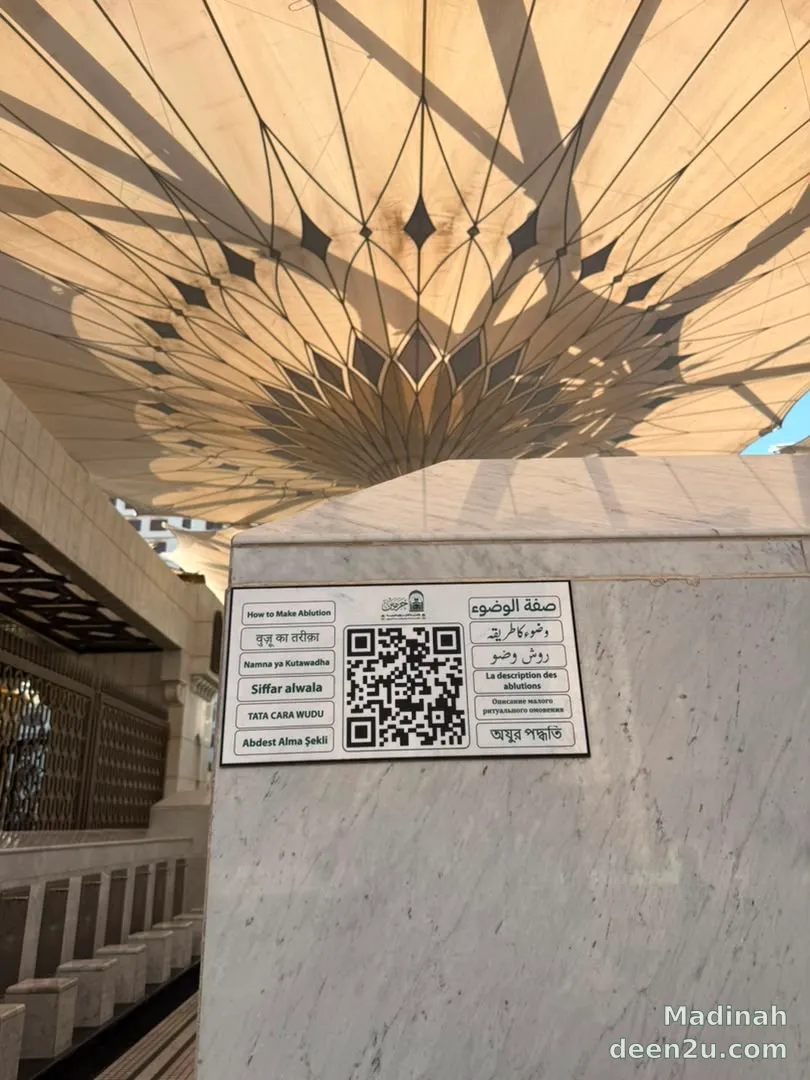
Wudu — the ablution before prayer
Full step-by-step guide: Wudu.
Prayer requires being in a state of ritual purity. Wudu is the washing that achieves this. Allah says in the Quran (Surah al-Ma'idah 5:6): "O you who believe, when you rise to pray, wash your faces and your hands up to the elbows, wipe your heads, and wash your feet up to the ankles." These four are the Quranic obligations; the Sunnah adds the fuller sequence below. Begin with the intention (niyyah) in the heart to purify yourself for worship. The exact order below — hands, then mouth and nose, then face, then arms, then head, then feet — follows the Companion Uthman ibn Affan's (رضي الله عنه) own demonstration of how the Prophet ﷺ performed wudu (Sahih al-Bukhari 159): the initial hand-wash up to the wrist is a preparatory sunnah step, distinct from washing the arms to the elbow in step 5, which is one of the four Quranic obligations above.
Khuffs — wiping over footwear instead of washing the feet
Step 7 can be replaced with a concession: wiping over khuffs (leather socks or boots) or thick socks instead of removing them and washing the feet — something the Prophet ﷺ himself practiced and taught (Sahih Muslim 274).
- The footwear was put on after a complete wudu — feet already fully washed and pure first
- Sturdy enough to be walked in without water passing through, per the majority view (some scholars extend this to ordinary thick socks)
- Wipe once — wet fingers passed over the top of each foot, toes toward the shin; the sole and heel are not wiped
- One full day and night for a resident
- Three days and nights for a traveller
- Counted from the first time wudu is broken after putting the footwear on — not from when it was first worn
- Once the time expires, the feet must be washed normally at the next wudu
After finishing, it is a recommended Sunnah to say the Shahada — whoever completes wudu well and then says it has all eight gates of Paradise opened for them, to enter from whichever they wish (Sahih Muslim 234). Once broken, wudu must be renewed before the next prayer — but not everything that feels significant actually breaks it. Certainty matters more than doubt: "He should not leave his prayers unless he hears sound or smells something" (Sahih al-Bukhari 137) — a vague feeling that something happened isn't enough to invalidate a wudu you know you have.
- Using the toilet — urine, stool, or passing wind
- Deep sleep that removes awareness of one's surroundings
- Loss of consciousness — fainting, intoxication
- Touching one's own private part directly, bare hand (majority view; Sunan Abi Dawud 181) — the Hanafi school holds this does not break wudu
- Eating camel meat, in the Hanbali view only (Sahih Muslim 360) — the majority hold it doesn't
- Touching your spouse without desire (Hanafi view; other schools differ — see the Rulings page for the full madhhab breakdown)
- Vomiting, in the majority view (Hanafi holds a mouthful does)
- Bleeding from a cut or wound, in the majority view (Hanafi holds flowing blood does)
- Touching the opposite gender without desire, in the Hanafi view
- Ordinary eating and drinking (aside from camel meat, per the Hanbali view above)
- Laughing, crying, or minor doubt without certainty
Ghusl — the full ritual bath
Full step-by-step guide: Ghusl.
Ghusl is the complete washing of the whole body required after janabah (major ritual impurity — following marital relations or the release of sexual fluid), and also for women after menstruation or postpartum bleeding ends. Without it, prayer, fasting-day validity of touching the Quran, and other acts of worship cannot proceed. Aisha (رضي الله عنها) described exactly how the Prophet ﷺ performed it (Sahih al-Bukhari 248 · Sahih Muslim 316):
Intention and Bismillah
Form the intention (niyyah) in the heart to purify yourself from janabah, and say Bismillah.
Wash the hands, then the private parts
Wash both hands up to the wrist three times, then wash away any impurity from the private area with the left hand.
Perform a complete wudu
Make wudu exactly as for prayer. Many delay washing the feet until the very end, when standing in pooled water, though washing them now is also valid.
Work water into the hair roots
Run wet fingers through the hair down to the scalp so water reaches the roots — women need not undo braids, as long as water reaches the scalp.
Pour water over the head three times
Pour three full handfuls of water over the head, letting it run down.
Pour over the whole body — right side, then left
Pour water over the right side of the body, then the left, making sure it reaches every part: underarms, navel, behind the ears, between the toes, and any skin folds. If the feet weren't washed in Step 3, wash them now.
Tayammum — the dry ablution
Full step-by-step guide: Tayammum.
Tayammum is purification with clean earth in place of water, when water is absent or its use would cause harm — granted in the same verse that commands wudu and ghusl: "…and you find no water, then perform tayammum with clean earth, wiping your faces and your hands with it" (Quran 5:6). It stands in for both wudu and, when in janabah, ghusl. The method the Prophet ﷺ taught 'Ammar ibn Yasir (رضي الله عنه) is a single strike of the hands, then wiping the face and hands (Sahih al-Bukhari 347 · Sahih Muslim 368).
Tayammum is broken by everything that breaks wudu — and by the availability of water, or the removal of the excuse (recovery from the illness that made water harmful). A prayer already offered with a valid tayammum is complete and not repeated (Sunan Abi Dawud 338).
The Adhan — why it's called, and how
The adhan is the call to prayer, announced aloud five times a day to summon the community — not written down or texted, but genuinely called out, traditionally from the mosque. Its wording wasn't decided by committee: a companion, Abdullah ibn Zayd (رضي الله عنه), described a dream in which a man taught him the exact phrases, and when he told the Prophet ﷺ, he confirmed it as a true vision and had it called from then on — with Bilal ibn Rabah (رضي الله عنه), chosen for his fine voice, becoming Islam's first muezzin (Sunan Abi Dawud 499, Jami' at-Tirmidhi 189).
| Phrase | Arabic | Meaning | Said |
|---|---|---|---|
| Takbir | اللَّهُ أَكْبَرُ، اللَّهُ أَكْبَرُ، اللَّهُ أَكْبَرُ، اللَّهُ أَكْبَرُ | Allah is greatest | 4×, opening |
| Shahada (Allah) | أَشْهَدُ أَنْ لَا إِلَٰهَ إِلَّا اللَّهُ | I bear witness there is no god but Allah | 2× |
| Shahada (Muhammad ﷺ) | أَشْهَدُ أَنَّ مُحَمَّدًا رَسُولُ اللَّهِ | I bear witness Muhammad is Allah's Messenger | 2× |
| Call to prayer | حَيَّ عَلَى الصَّلَاةِ | Come to prayer | 2× |
| Call to success | حَيَّ عَلَى الْفَلَاحِ | Come to success | 2× |
| Fajr only | الصَّلَاةُ خَيْرٌ مِنَ النَّوْمِ | Prayer is better than sleep | 2×, Fajr adhan only |
| Takbir | اللَّهُ أَكْبَرُ، اللَّهُ أَكْبَرُ | Allah is greatest | 2× |
| Closing | لَا إِلَٰهَ إِلَّا اللَّهُ | There is no god but Allah | 1×, closing |
Responding to the adhan
It's sunnah to quietly repeat each phrase as you hear it — with one exception: when the muezzin calls "Hayya 'ala-s-salah" or "Hayya 'ala-l-falah," the listener responds instead with "La hawla wa la quwwata illa billah" (there is no power or strength except with Allah), rather than repeating the phrase itself (Sahih Muslim 385). After the adhan ends, it's recommended to send salawat on the Prophet ﷺ and say the dua the Prophet ﷺ promised his own intercession for whoever recites it:
اللَّهُمَّ رَبَّ هَٰذِهِ الدَّعْوَةِ التَّامَّةِ وَالصَّلَاةِ الْقَائِمَةِ آتِ مُحَمَّدًا الْوَسِيلَةَ وَالْفَضِيلَةَ وَابْعَثْهُ مَقَامًا مَحْمُودًا الَّذِي وَعَدْتَهُ
Allahumma Rabba hadhihid-da'watit-tammah, was-salatil-qa'imah, ati Muhammadanil-wasilata wal-fadilah, wab'ath-hu maqaman mahmudanil-ladhi wa'adtah
"O Allah, Lord of this perfect call and established prayer, grant Muhammad the intercession and favor, and raise him to the praised station You have promised him." Whoever says this after the adhan, the Prophet's ﷺ own intercession becomes rightfully his on the Day of Resurrection (Sahih al-Bukhari 614).
The iqamah — the second, shorter call
Just before the prayer itself begins, a second, brief call — the iqamah — is given, usually by the same muezzin, signaling that the rows are forming and prayer is starting. Anas ibn Malik reported that Bilal was instructed to say the adhan's phrases in pairs but the iqamah's singly — except for one line repeated twice: "Qad qamatis-salah" (the prayer has now begun), added right before the closing takbir (Sahih al-Bukhari 607).
| Phrase | Arabic | Meaning | Said |
|---|---|---|---|
| Takbir | اللَّهُ أَكْبَرُ، اللَّهُ أَكْبَرُ | Allah is greatest | 2×, opening |
| Shahada (Allah) | أَشْهَدُ أَنْ لَا إِلَٰهَ إِلَّا اللَّهُ | I bear witness there is no god but Allah | 1× |
| Shahada (Muhammad ﷺ) | أَشْهَدُ أَنَّ مُحَمَّدًا رَسُولُ اللَّهِ | I bear witness Muhammad is Allah's Messenger | 1× |
| Call to prayer | حَيَّ عَلَى الصَّلَاةِ | Come to prayer | 1× |
| Call to success | حَيَّ عَلَى الْفَلَاحِ | Come to success | 1× |
| The prayer has begun | قَدْ قَامَتِ الصَّلَاةُ | The prayer has now begun | 2× |
| Takbir | اللَّهُ أَكْبَرُ، اللَّهُ أَكْبَرُ | Allah is greatest | 2× |
| Closing | لَا إِلَٰهَ إِلَّا اللَّهُ | There is no god but Allah | 1×, closing |
Where you may pray — the whole earth is a masjid
Before the "how" comes a question many new Muslims — and plenty of lifelong Muslims — quietly wonder about: do you need a prayer mat, and does prayer only "count" on one? The answer, straight from the Prophet ﷺ, is freeing. He was given something no prophet before him was given: the entire earth as his place of prayer. You can pray on grass, on carpet, on a bare floor, on sand, on stone — anywhere clean, facing the Kaaba. The mat is a convenience, not a condition.
وَجُعِلَتْ لِيَ الْأَرْضُ مَسْجِدًا وَطَهُورًا
wa juʿilat liya-l-arḍu masjidan wa ṭahūrā
"…the earth has been made for me a place of prayer (masjid) and a means of purification — so wherever a man of my ummah is when the prayer overtakes him, let him pray." Part of the hadith of the five things the Prophet ﷺ was given that no prophet before him received.Sahih al-Bukhari 335 · Sahih Muslim 521
Read that carefully: the ground itself was declared a masjid. A masjid is not only the building with the dome and minaret — the word means a place of prostration, and the Prophet ﷺ was told the whole earth is exactly that. This is why a Muslim caught by the prayer time in an office, a park, an airport, a field, or at the roadside simply prays where they are. No building, no mat, and no special object is required for the prayer to be valid and complete.
The one real condition: a clean spot
What the earth-is-a-masjid hadith asks for is not a mat but purity of the place (ṭahārat al-makān) — the spot you pray on should be free of visible impurity (najasah) such as urine, droppings, or blood. That is the whole condition. When a bedouin once urinated in the Prophet's mosque, the Prophet ﷺ did not rebuke him harshly or dig up the ground; he had a bucket of water poured over the spot to purify it and taught the man gently.Sahih al-Bukhari 220 A clean floor, a clean carpet, clean earth — all are ready places of prayer just as they are.
What the Prophet ﷺ actually prayed on
The Sunnah shows real variety — and that variety is the point. He ﷺ prayed directly on the earth and prayed on simple mats, using whatever was to hand:
- On bare earth, and even in mud. On the night of Laylatul Qadr he prostrated in rain-softened ground, and the companions saw the traces of mud and water on his forehead and nose when he rose.Sahih al-Bukhari 813
- On a khumra — a small mat of woven palm-fibre, just large enough for the face and hands in prostration. Maymuna (رضي الله عنها) reported: "Allah's Messenger ﷺ used to pray on Khumra"Sahih al-Bukhari 381
- On a hasir — a larger reed mat. Anas ibn Malik described praying behind the Prophet ﷺ at his grandmother's house on a mat darkened by long use, sprinkled with water first to freshen it.Sahih al-Bukhari 380
- On a garment, in scorching heat. Anas said that when the ground was too hot to place the forehead on, a companion would spread part of his robe and prostrate on it.Sahih al-Bukhari 385
So a mat beneath you is fully in keeping with his ﷺ practice — he used mats. What the Sunnah never does is make a particular mat, or any mat at all, a requirement. The khumra and the hasir were plain household matting to keep off dust, heat, and damp; they were not sacred objects, and prayer on the open ground beside them was equally his ﷺ practice.
The sajjadah (prayer mat) — what it is, required or cultural?
The prayer mat has a proper name: the sajjadah (سَجَّادَة), from the same root as sujud — literally "the thing you prostrate upon." (Don't confuse it with the musalla, which is the wider place of prayer — a spread-out spot, a prayer room, or the open Eid ground.) The concept is simple and old: something clean laid down between you and the floor. The Prophet's ﷺ own version was the plain palm-fibre khumra and reed hasir above — functional matting, not decoration.
So is it religious or cultural? Both — and it helps to separate the two. The idea of a clean thing beneath you is rooted in the Sunnah. The ornate, dedicated prayer rug we picture today — the velvet pile, the woven mihrab arch, the tassels and florals — is a later cultural elaboration of that idea: beautiful, useful, region by region, and entirely permissible, but never something the Prophet ﷺ owned, prescribed, or made a condition. A sajjadah earns its keep for three practical reasons, none of which is "the prayer needs it":
- Guaranteeing a clean spot on an unknown or dusty floor
- Marking your space so others don't cross in front of you
- Comfort for the knees and forehead on hard ground
- A condition for the prayer to be valid
- Required for prostration — any clean surface works
- A sacred object; it needs no ritual or special reverence
Prostration (sujud) is valid on anything clean — earth, stone, carpet, wood, tile, or cloth. The Prophet ﷺ prostrated on all of these. The mainstream Sunni position sets no requirement to prostrate on a particular material, and there is no basis in the Sunnah for needing a special clay tablet or stone beneath the forehead; the seven bones of prostration — the forehead (together with the nose), the two palms, the two knees, and the tips of the two feet — simply rest on the clean ground or covering in front of you.Sahih al-Bukhari 812 · Sahih Muslim 490
The takeaway. If you have a mat, use it — it follows his ﷺ practice and it is practical. If you don't, nothing is missing: step onto any clean patch of ground, face the qiblah, and pray. The Prophet ﷺ was given the whole earth as a masjid so that no Muslim would ever be left unable to stand before their Lord for lack of a special place.
The sutrah — a barrier in front of the one praying
Closely tied to where you pray is what you place in front of you. A sutrah (سُتْرَة — literally a "screen") is anything set a short distance ahead of the place of prostration and prayed toward: a wall, a pillar, a chair, a planted stick, even a bag. It was the Prophet's ﷺ settled practice — a short spear (harba) would be planted in front of him and he would pray toward it.Sahih al-Bukhari 498 The sutrah marks off the space of your prayer so that others can pass beyond it freely — and so your own eyes and mind have a defined space in which to settle.
إِذَا صَلَّى أَحَدُكُمْ إِلَى شَيْءٍ يَسْتُرُهُ مِنَ النَّاسِ فَأَرَادَ أَحَدٌ أَنْ يَجْتَازَ بَيْنَ يَدَيْهِ فَلْيَدْفَعْهُ
Idhā ṣallā aḥadukum ilā shayʾin yasturuhu mina-n-nās, fa-arāda aḥadun an yajtāza bayna yadayhi, falyadfaʿhu
"When one of you prays toward something that screens him from the people, and someone tries to pass in front of him, let him push him back…" — and the hadith continues that if the passer insists, he is repelled more firmly, "for he is only a devil."Sahih al-Bukhari 509 · Sahih Muslim 505
Notice what the wording takes for granted: that the one praying is praying toward something that screens him. The great majority of scholars class the sutrah as a stressed Sunnah (sunnah mu'akkadah) — the prayer is valid without it, but the Prophet's ﷺ consistent practice and his instruction above give it real weight, especially anywhere people may walk past. It protects the passer-by too: the Prophet ﷺ said that if the one who passes in front of a praying person knew the sin of it, he would rather stand waiting forty — the narrator was unsure whether he said days, months, or years — than cross in front of him.Sahih al-Bukhari 510 In congregation, the imam's sutrah serves the rows behind him — in the spear narrations it stood in front of the Prophet ﷺ alone while the companions prayed behind.Sahih al-Bukhari 495
How to pray — Salah step by step
Below is a single unit of prayer, called a rak'ah. Each of the five daily prayers is simply a number of rak'ahs repeated in the same pattern. Face the Kaaba (the qiblah), stand with the intention of the specific prayer in your heart, and begin.
Step 1 · Takbir al-Ihram — opening the prayer
Raise your hands to your shoulders or ears and begin the prayer by saying:
اللَّهُ أَكْبَرُ
Allāhu Akbar
"Allah is the Greatest." From this moment you are in prayer; worldly speech and movement stop.
Step 2 · Qiyam — standing and reciting al-Fatihah
Place the right hand over the left on the chest and recite the opening chapter, Surah al-Fatihah, in full — it is obligatory in every rak'ah:
بِسْمِ ٱللَّهِ ٱلرَّحْمَـٰنِ ٱلرَّحِيمِ
Bismi-llāhi-r-Raḥmāni-r-Raḥīm
"In the name of Allah, the Most Merciful, the Bestower of Mercy." 1:1
ٱلْحَمْدُ لِلَّهِ رَبِّ ٱلْعَـٰلَمِينَ
Al-ḥamdu lillāhi rabbi-l-ʿālamīn
"All praise is due to Allah, Lord of all the worlds." 1:2
إِيَّاكَ نَعْبُدُ وَإِيَّاكَ نَسْتَعِينُ
Iyyāka naʿbudu wa iyyāka nastaʿīn
"It is You we worship and You we ask for help." 1:5
صِرَٰطَ ٱلَّذِينَ أَنْعَمْتَ عَلَيْهِمْ غَيْرِ ٱلْمَغْضُوبِ عَلَيْهِمْ وَلَا ٱلضَّآلِّينَ
Ṣirāṭa-lladhīna anʿamta ʿalayhim, ghayri-l-maghḍūbi ʿalayhim wa lā-ḍ-ḍāllīn
"The path of those upon whom You have bestowed favor — not of those who have earned Your anger, nor of those who have gone astray." 1:7
After al-Fatihah it is sunnah to say Āmīn ("answer us") Sahih al-Bukhari 780. In the first two rak'ahs, a further short passage of the Quran is then recited; Arabic text above follows the site's Tanzil-sourced Uthmani dataset (read al-Fatihah in the Quran reader).
Step 3 · Ruku — bowing
Say Allahu Akbar, then bow with a straight back, hands on the knees, and say three times:
سُبْحَانَ رَبِّيَ الْعَظِيمِ
Subḥāna rabbiya-l-ʿaẓīm
"Glory be to my Lord, the Most Great."
Step 4 · Standing up from ruku (i'tidal)
Rise to standing while saying:
سَمِعَ اللَّهُ لِمَنْ حَمِدَهُ
Samiʿa-llāhu liman ḥamidah
"Allah hears the one who praises Him." Once fully standing, respond: Rabbanā wa laka-l-ḥamd — "Our Lord, and to You is all praise."
Step 5 · Sujood — prostration
Say Allahu Akbar and prostrate so that seven parts touch the ground: the forehead and nose, both palms, both knees, and the toes of both feet. Say three times:
سُبْحَانَ رَبِّيَ الْأَعْلَى
Subḥāna rabbiya-l-aʿlā
"Glory be to my Lord, the Most High."
Then say Allahu Akbar, sit up briefly, and prostrate a second time saying the same words. This completes one rak'ah.
Step 6 · Tashahhud — the sitting testimony
After every second rak'ah, and at the end of the prayer, sit and recite the tashahhud:
التَّحِيَّاتُ لِلَّهِ وَالصَّلَوَاتُ وَالطَّيِّبَاتُ السَّلَامُ عَلَيْكَ أَيُّهَا النَّبِيُّ وَرَحْمَةُ اللَّهِ وَبَرَكَاتُهُ
At-taḥiyyātu lillāhi wa-ṣ-ṣalawātu wa-ṭ-ṭayyibāt, as-salāmu ʿalayka ayyuha-n-nabiyyu wa raḥmatu-llāhi wa barakātuh…
"All greetings, prayers and good things are for Allah. Peace be upon you, O Prophet, and the mercy of Allah and His blessings…" This continues with the testimony of faith and, in the final sitting, blessings upon the Prophet ﷺ (the salawat).
Step 7 · Taslim — ending the prayer
Turn the face to the right, then to the left, each time saying:
السَّلَامُ عَلَيْكُمْ وَرَحْمَةُ اللَّهِ
As-salāmu ʿalaykum wa raḥmatu-llāh
"Peace and the mercy of Allah be upon you." With this the prayer is complete.
If you forget a step · Sujud al-Sahw — the prostration of forgetfulness
Forgetting in prayer is human — it happened to the Prophet ﷺ himself, and he showed exactly how to mend it: two extra prostrations, just like the prostrations of prayer, called sujud al-sahw. He said: "I am a human being like you and liable to forget like you. So if I forget remind me and if anyone of you is doubtful about his prayer, he should follow what he thinks to be correct and complete his prayer accordingly and finish it and do two prostrations (of Sahu)" Sahih al-Bukhari 401 · Sahih Muslim 572
Three situations, each with his ﷺ own precedent:
- You added something (an extra rak'ah, an extra sitting). When the Prophet ﷺ once prayed Dhuhr as five rak'ahs and was asked about it, he turned toward the qiblah after the salam and prostrated twice. Sahih al-Bukhari 1226 · Sahih Muslim 572
- You left something out (most commonly the middle tashahhud). When he ﷺ once stood straight up from the second rak'ah without sitting, he continued the prayer, then prostrated twice before the salam, and made salam after. Sahih al-Bukhari 829 · Sahih Muslim 570 And when he once ended the prayer after only two rak'ahs and Dhul-Yadayn asked "has the prayer been shortened, or did you forget?", he completed what was missed, made salam, then prostrated twice. Sahih al-Bukhari 482 · Sahih Muslim 573
- You're not sure how much you prayed (three or four?). Build on what you are certain of — the lower number — complete the prayer, and prostrate twice before the salam: "If one of you is in doubt in his prayer and does not know whether he prayed three or four, let him cast away the doubt and build upon what is certain, then prostrate twice before the taslim." Sahih Muslim 571
How to do it: each of the two prostrations is exactly like a normal prostration — say Allahu Akbar going down, glorify Allah as usual (Subḥāna rabbiya-l-aʿlā), sit briefly between them, and prostrate again. Whether they come just before or just after the final salam follows the cases above; the schools organize these precedents slightly differently (the Hanafi school generally places them after the salam, the Shafi'i school before, the Maliki school before for omissions and after for additions) — all of it rests on the same sahih incidents, so whichever pattern your teacher or local mosque follows is sound. Sujud al-sahw mends forgetfulness; it does not replace a missed pillar (like ruku or sujud itself), which must be performed.
Mandatory vs. recommended recitations
The steps above mix two different kinds of recitation: a small core that's obligatory — the prayer isn't valid without it — and a larger set the Prophet ﷺ recited habitually, which is deeply recommended but doesn't invalidate the prayer if left out. Where the four schools of law (madhhabs) genuinely differ on which category something falls into, that's noted rather than picking a side.
- Takbir al-Ihram — the opening "Allahu Akbar"
- Surah al-Fatihah, in every single rak'ah — "Whoever does not recite Al-Fatiha in his prayer, his prayer is invalid"Sahih al-Bukhari 756, Sahih Muslim 394
- The final tashahhud (the sitting testimony at the end of the prayer)
- Taslim — the act that closes the prayerSunan Abi Dawud 61, Jami' at-Tirmidhi 3 — jurists hold that saying "as-salaam" once is the minimum that fulfills it
- An additional surah or passage after al-Fatihah in the first two rak'ahs — sunnah in the Maliki, Shafi'i, and Hanbali schools; the Hanafi school treats it as wajib (necessary, a notch below fard) in those same two rak'ahs specifically
- The specific wording and threefold repetition of tasbih in ruku ("Subhana rabbiyal azeem") and sujood ("Subhana rabbiyal a'la") — some glorification there is from his consistent practice, but the exact phrase and count are sunnah, not a pillar, across the major schoolsSahih Muslim 479a, Sahih Muslim 772
- "Sami Allahu liman hamidah" and "Rabbana wa lakal hamd" when rising from ruku
- The first (middle) tashahhud, after the 2nd rak'ah in a 3- or 4-rak'ah prayer — sunnah per the Shafi'i school and the majority view; wajib per the Hanafi and Hanbali schools
- Salawat — blessings on the Prophet ﷺ — in the final tashahhud: scholars hold three different positions on this one, ranging from an essential pillar to simply recommended, so it's genuinely disputed rather than a settled sunnah
- A free personal dua after the final tashahhud, before the salam — he ﷺ explicitly told a companion to "choose whichever supplication pleases him"Sahih al-Bukhari 835, Sahih Muslim 402a
The final sitting is fuller — not stretched
A common misunderstanding is that the last sitting of the prayer is "longer" because you draw out the syllables of At-taḥiyyāt — holding the words, slowing the pace to fill the time. That isn't it. The words of the tashahhud are the same in the first (middle) sitting and in the last. The final sitting is longer because it contains more: after the very same At-taḥiyyāt you add three further things the Prophet ﷺ taught and did — each of them brief, meaningful, and established in the ṣaḥīḥ Sunnah. The extra length is added content, not artificial stretching.
The full Ṣalawāt Ibrāhīmiyyah — blessings on the Prophet ﷺ and his family
Seeking refuge in Allah from four things
A supplication of your own choosing, before the salam
1 · The full Ṣalawāt Ibrāhīmiyyah — blessings on the Prophet ﷺ
When a companion asked how they were to send blessings upon him, the Prophet ﷺ taught the exact wording — the same salawat named at the end of the tashahhud step above:
اللَّهُمَّ صَلِّ عَلَى مُحَمَّدٍ وَعَلَى آلِ مُحَمَّدٍ كَمَا صَلَّيْتَ عَلَى إِبْرَاهِيمَ وَعَلَى آلِ إِبْرَاهِيمَ إِنَّكَ حَمِيدٌ مَجِيدٌ اللَّهُمَّ بَارِكْ عَلَى مُحَمَّدٍ وَعَلَى آلِ مُحَمَّدٍ كَمَا بَارَكْتَ عَلَى إِبْرَاهِيمَ وَعَلَى آلِ إِبْرَاهِيمَ إِنَّكَ حَمِيدٌ مَجِيدٌ
Allāhumma ṣalli ʿalā Muḥammadin wa ʿalā āli Muḥammad, kamā ṣallayta ʿalā Ibrāhīma wa ʿalā āli Ibrāhīm, innaka ḥamīdun majīd. Allāhumma bārik ʿalā Muḥammadin wa ʿalā āli Muḥammad, kamā bārakta ʿalā Ibrāhīma wa ʿalā āli Ibrāhīm, innaka ḥamīdun majīd.
"O Allah! Send Your Mercy on Muhammad and on the family of Muhammad, as You sent Your Mercy on Abraham and on the family of Abraham, for You are the Most Praise-worthy, the Most Glorious. O Allah! Send Your Blessings on Muhammad and the family of Muhammad, as You sent your Blessings on Abraham and on the family of Abraham, for You are the Most Praise-worthy, the Most Glorious"Sahih al-Bukhari 3370 · Sahih Muslim 406
Its status in the final tashahhud is genuinely debated — as noted in the recitations reference above, scholars range from treating it as an essential pillar of the prayer (the well-known Shafi'i position, and one report from the Hanbali school) to a strongly emphasized recommendation (the Hanafi and Maliki view). What is not disputed is that it belongs here, in this wording, from the Prophet's ﷺ own teaching.
2 · The four seekings of refuge
The Prophet ﷺ gave a direct command for this sitting: "When one of you finishes the last tashahhud, let him seek refuge in Allah from four things: from the punishment of Hell, from the punishment of the grave, from the trials of life and death, and from the evil of the trial of the Masīḥ ad-Dajjāl." Sahih Muslim 588 · Sahih al-Bukhari 1377
اللَّهُمَّ إِنِّي أَعُوذُ بِكَ مِنْ عَذَابِ جَهَنَّمَ وَمِنْ عَذَابِ الْقَبْرِ وَمِنْ فِتْنَةِ الْمَحْيَا وَالْمَمَاتِ وَمِنْ شَرِّ فِتْنَةِ الْمَسِيحِ الدَّجَّالِ
Allāhumma innī aʿūdhu bika min ʿadhābi jahannam, wa min ʿadhābi-l-qabr, wa min fitnati-l-maḥyā wa-l-mamāt, wa min sharri fitnati-l-Masīḥi-d-Dajjāl.
"O Allah, I seek refuge in You from the punishment of Hell, from the punishment of the grave, from the trials of life and death, and from the evil of the trial of the Masīḥ ad-Dajjāl."Sahih Muslim 588
Because the wording arrives as a command, some scholars — including Ibn Ḥazm, and Ibn al-Qayyim relaying a report from Imam Ahmad — held this seeking of refuge to be obligatory in the last sitting. The majority of the four schools read the command as a strong recommendation (mustaḥabb) rather than a condition of validity. Either way it is from the Sunnah, and no one treated it as optional padding.
3 · Then a supplication of your own choosing
After the tashahhud and salawat, and before the closing salam, the Prophet ﷺ opened the door to personal du'a. In Ibn Masʿūd's report of the tashahhud he ﷺ concluded: "then let him choose whatever supplication he likes and supplicate." Sahih al-Bukhari 835 · Sahih Muslim 402 This is the free, unscripted plea — in any words, for anything good — that the recitations reference above already flags. It is where the fixed form of the prayer gives way, for a moment, to the worshipper's own need.
Prayer while travelling — and when you can't pray the usual way
Full guide: Prayer while travelling.
Islam does not suspend the prayer because the road gets long or life gets hard — it lightens it. A traveller shortens; someone who can't stand sits; someone who can't find water uses clean earth; someone stuck in a moving vehicle gestures. None of these are loopholes invented later. Each is the Prophet's ﷺ own recorded practice, and Allah frames the whole set of them as mercy: "Allah intends ease for you, and does not intend hardship" (Quran 2:185).
Qasr — shortening four rak'ahs to two
On a journey the three four-rak'ah prayers — Dhuhr, Asr, and Isha — are each prayed as two rak'ahs. Fajr (already two) and Maghrib (three) are never shortened. This is the plain sense of the verse:
وَإِذَا ضَرَبْتُمْ فِي الْأَرْضِ فَلَيْسَ عَلَيْكُمْ جُنَاحٌ أَن تَقْصُرُوا مِنَ الصَّلَاةِ
wa idhā ḍarabtum fi-l-arḍi fa-laysa ʿalaykum junāḥun an taqṣurū mina-ṣ-ṣalāh
"And when you travel through the land, there is no blame on you for shortening the prayer."Quran 4:101
Ibn 'Umar (رضي الله عنه) said he accompanied the Prophet ﷺ on journeys and "he never prayed more than two rak'ahs" on the road — and Abu Bakr, 'Umar, and 'Uthman did the same after him.Sahih al-Bukhari 1102 The schools differ on the exact distance and length of stay that make you a "traveller," but the concession itself is not disputed; shortening on a real journey is the established Sunnah, not merely tolerated.
Jam' — combining two prayers into one time
A separate concession lets a traveller — or someone facing genuine hardship such as heavy rain or illness — combine two prayers in the time of one: Dhuhr with Asr, and Maghrib with Isha. Fajr always stands on its own. You may bring them together early, in the first prayer's window (jam' taqdim), or late, in the second's (jam' ta'khir) — whichever the journey allows.
Ibn 'Abbas (رضي الله عنه) reported that the Prophet ﷺ joined Dhuhr with Asr, and Maghrib with Isha. Asked why, he explained he did not want to put his ummah to hardship.Sahih Muslim 705
Praying on a plane, train, car, or bus
The order of preference is straightforward: pray the obligatory prayer properly on the ground, facing the qiblah, whenever you can stop to do so. When you truly cannot — a plane in flight, a coach that won't pull over — pray where you are rather than let the time slip away. Face the qiblah for the opening takbir if that's possible, then:
Do
- Stand if the space allows; otherwise pray seated
- Gesture (ima') for ruku and sujud with a bow of the head
- Make the sujud gesture lower than the ruku gesture
- Recite Fatihah and everything else exactly as normal
Don't
- Drop the prayer because the seat won't let you prostrate fully
- Panic if the vehicle turns you off the qiblah mid-prayer
- Prop a tray or bag up to prostrate onto it — the head-nod is the sunnah, not a raised object
The seated concession comes straight from the Prophet ﷺ. When 'Imran ibn Husayn (رضي الله عنه), who suffered from piles, asked how to pray, he ﷺ said: "Pray while standing and if you can't, pray while sitting and if you cannot do even that, then pray Lying on your side"Sahih al-Bukhari 1117 And the head-gesture, with the prostration made lower than the bowing, is exactly how he ﷺ prayed on his mount, as Jabir (رضي الله عنه) described.Jami' at-Tirmidhi 351 — hasan sahih
Tayammum — dry ablution when there's no water
Full guide: Tayammum.
If there's no water, or using it would harm you because of illness or bitter cold, purity is still within reach: tayammum, using clean earth. The Quran grants it twice — in the verses on wudu and on prayer:
"…and if you find no water, then take clean earth and wipe your faces and your hands with it."Quran 4:43 · Quran 5:6
The method the Prophet ﷺ taught 'Ammar ibn Yasir (رضي الله عنه) is brief: strike the clean earth once with both palms, blow off the excess, then wipe the face and the backs of the hands.Sahih al-Bukhari 338 That single tayammum stands in for wudu — or for ghusl when in janabah — until water is available, at which point you wash as normal.
Nafl on the move — voluntary prayer facing any direction
Voluntary (nafl) prayer is lighter still. On a journey the Prophet ﷺ prayed his optional prayers, and his witr, while riding — nodding for the movements and letting the mount face wherever it was headed, without turning to the qiblah at all.
Ibn 'Umar (رضي الله عنه) said the Prophet ﷺ used to pray optional prayers on his mount whichever way it faced, and prayed witr on it — but he would not pray the obligatory prayer on it.Sahih al-Bukhari 1000
That last clause is the point: this freedom is for voluntary prayer. The five obligatory prayers keep their full form and their qiblah wherever it is humanly possible — the concessions above are for when it genuinely is not.
The five daily prayers and their times
Each prayer has a window of time defined by the sun. The number of obligatory (fard) rak'ahs is fixed; many Muslims add recommended (Sunnah) rak'ahs before or after.
| Prayer | Arabic | Time | Fard rak'ahs |
|---|---|---|---|
| Fajr | الفجر | From dawn until sunrise | 2 |
| Dhuhr | الظهر | After the sun passes its zenith (midday) | 4 |
| Asr | العصر | Late afternoon until sunset | 4 |
| Maghrib | المغرب | Just after sunset | 3 |
| Isha | العشاء | After twilight, through the night | 4 |
Prayer times shift daily with the sun and your location. You can find accurate times for where you are on the Prayer Times page.
When it's forbidden to pray
Three windows each day are set aside — not for the obligatory prayers, which are never forbidden, but for voluntary prayer and burying the dead. Uqbah ibn Amir reported: "There are three hours the Messenger of Allah ﷺ used to forbid us from praying or burying our deceased: when the sun begins to rise until it is fully up, when it is at its zenith until it declines, and when it begins to set until it has fully set" (Sahih Muslim 831). A related hadith adds the two windows after the obligatory prayers: "The Prophet ﷺ forbade praying after the Fajr prayer till the sun rises and after the `Asr prayer till the sun sets" (Sahih al-Bukhari 581).
| Window | Why |
|---|---|
| Right at sunrise, until the sun is fully up (~15–20 min) | The sun rises between the "two horns of Shaytan" — a time of sun-worship in pre-Islamic practice |
| At the sun's zenith, just before Dhuhr begins | The same reasoning — this is when Hellfire is described as being "stoked" in one narration |
| Right at sunset, until it is fully down | The sun sets between the same "two horns of Shaytan" |
| After Fajr until sunrise | A broader window avoiding voluntary prayer once the obligatory Fajr is done |
| After Asr until sunset | A broader window avoiding voluntary prayer once the obligatory Asr is done |
This restriction is on voluntary prayer with no specific reason — it doesn't apply to making up a missed obligatory prayer, funeral prayer when necessary, or prayers with a specific cause, like the two rak'ahs after wudu or entering a mosque (tahiyyatul masjid), where scholars differ on whether those specific-cause prayers are excepted.
Sunnah rawatib — the voluntary prayers the Prophet ﷺ never left
Alongside the five obligatory prayers, the Prophet ﷺ regularly prayed a set of voluntary units before (qabliyah) or after (ba'diyah) certain prayers. His wife Umm Habiba reported him saying: "Whoever prays twelve rak'ahs in a day and night, a house will be built for him in Paradise" (Sahih Muslim 728) — and these twelve are exactly the set below.
| Prayer | Qabliyah (before) | Ba'diyah (after) | How he ﷺ performed it |
|---|---|---|---|
| Fajr | 2 rak'ahs | — | The most emphasized of all — he said these "are better than the world and everything in it" (Sahih Muslim 725). Prayed lightly and briefly, at home, before leaving for the mosque. |
| Dhuhr | 4 rak'ahs (as 2+2) | 2 rak'ahs | The 4 before are sometimes prayed as one continuous set; the 2 after are shorter. |
| Asr | — | — | No confirmed rawatib, though praying 4 extra rak'ahs beforehand is a separate, lighter recommendation. |
| Maghrib | — | 2 rak'ahs | Prayed promptly after the obligatory prayer, traditionally at home. |
| Isha | — | 2 rak'ahs | The last of the twelve; often followed shortly after by Witr. |
Two habits are worth copying directly from his example: he preferred to pray these voluntary rak'ahs at home rather than the mosque — "the best prayer of a person is that which he prays in his house except the compulsory prayers" (Sahih al-Bukhari 731) — and he closed the night with Witr (covered in its own section just below). None of the rawatib are sins to miss occasionally, but he ﷺ was consistent with them even while travelling, with the notable exception of the strongest one — the two before Fajr — which he kept even then.
Witr — how the Prophet ﷺ closed his night
Witr ("odd") is the odd-numbered prayer that seals the night's worship, prayed any time between Isha and the break of dawn. He ﷺ commanded it in general terms — "Make witr as your last prayer at night" Sahih al-Bukhari 998 · Sahih Muslim 751 — and its emphasis is so strong that the Hanafi school classes it as wajib (a binding duty just below fard), while the majority hold it an emphasized sunnah. How he actually performed it comes through clearly in the sahih narrations:
- The base unit is one rak'ah, built on pairs. When a questioner asked him ﷺ about night prayer, he said: "The night prayer is offered as two Rak`at followed by two Rak`at and so on and if anyone is afraid of the approaching dawn (Fajr prayer) he should pray one Rak`ah and this will be a Witr for all the Rak`at which he has prayed before" Sahih al-Bukhari 990 · Sahih Muslim 749 So Witr can be as little as one rak'ah — "Witr is a single rak'ah at the end of the night" Sahih Muslim 752 — or three, five, or more, so long as the night's total ends odd.
- His own most common pattern was eleven. Aisha described his night: "Allah's Messenger ﷺ used to pray eleven rak`at at night and that was his night prayer and each of his prostrations lasted for a period enough for one of you to recite fifty verses before Allah's Messenger ﷺ raised his head. He also used to pray two rak`at (Sunnah) before the (compulsory) Fajr prayer" Sahih al-Bukhari 994 In another description: four, then four, then three — "do not ask me about their beauty and length" Sahih al-Bukhari 1147 · Sahih Muslim 738
- Timing is flexible — anchored to your own night. "Whoever fears he will not get up at the end of the night, let him pray Witr at its beginning; and whoever hopes to rise at its end, let him pray Witr at the end of the night — for prayer at the end of the night is witnessed [by the angels], and that is better." Sahih Muslim 755 Aisha reported that he ﷺ prayed Witr at every part of the night at different times — its beginning, its middle, and its end — the constant was that it never got skipped. Sahih Muslim 745
- It pairs naturally with the rawatib above: after the two rak'ahs following Isha, pray what you are able two-by-two — even just one more pair — and close with a single or a set of three. For those who won't wake for tahajjud, Witr straight after Isha was exactly what the Prophet ﷺ advised Abu Hurairah: "My friend (the Prophet) advised me to do three things and I shall not leave them till I die, these are: To fast three days every month, to offer the Duha prayer, and to offer witr before sleeping" Sahih al-Bukhari 1178 · Sahih Muslim 721
Praying three rak'ahs of Witr is commonly done either as 2 + 1 (with a salam in between) or as a single set of three with one final sitting — both have basis among the schools; jurists only discourage making three-rak'ah Witr identical to Maghrib in form. The du'a of qunut within Witr is established practice reported in the Sunan collections (e.g. the wording taught to al-Hasan ibn Ali, Sunan Abi Dawud 1425, graded sahih by its editors) rather than in Bukhari/Muslim — so it is recommended, not required.
Where everyone stands, in congregation
Praying with even one other person changes where each of you stands — and it changes again with a second man, and again once women or children join. One follower stands beside the imam, on his right, a little behind; two or more form a row entirely behind him; a mixed group layers into rows, men nearest the imam, then children, then women furthest back. Every position traces back to the Prophet ﷺ physically placing companions with his own hands, each preserved in its own hadith. See the full guide, with diagrams and every citation →
Special congregational prayers
Beyond the five daily prayers, several other prayers follow their own distinct structure — some weekly, some yearly, some only when the community needs them.
| Prayer | When | Rak'ahs | Khutbah | Adhan / Iqamah |
|---|---|---|---|---|
| Jumu'ah (Friday) | Friday, replacing Dhuhr | 2 | Before the prayer | Both |
| Eid | Morning of Eid al-Fitr / al-Adha | 2 (with extra takbirs) | After the prayer | Neither |
| Taraweeh | Nightly in Ramadan, after Isha | 8 or 20, + Witr | None | Neither |
| Janazah (funeral) | Whenever a Muslim has died | 0 — 4 takbirs instead, no rak'ahs | None | Neither |
Jumu'ah — the Friday prayer
Full guide: Jumuʿah — the Friday Prayer.
Jumu'ah replaces Dhuhr every Friday and is obligatory on every adult male Muslim resident in the area (women, travellers, and the sick may attend but aren't obliged to). The Quran commands hastening to it: "O you who believe, when the call is made for prayer on Friday, hasten to the remembrance of Allah and leave off trade" (62:9). The Prophet ﷺ tied its reward directly to arriving early: "Any person who takes a bath on Friday like the bath of Janaba and then goes for the prayer (in the first hour i.e. early), it is as if he had sacrificed a camel (in Allah's cause); and whoever goes in the second hour it is as if he had sacrificed a cow; and whoever goes in the third hour, then it is as if he had sacrificed a horned ram; and if one goes in the fourth hour, then it is as if he had sacrificed a hen; and whoever goes in the fifth hour then it is as if he had offered an egg. When the Imam comes out (i.e. starts delivering the Khutba), the angels present themselves to listen to the Khutba" (Sahih al-Bukhari 881).
Ghusl, best clothes, and pleasant scent (men) — then arrive early
Two sermons from the minbar, separated by a brief sitting — listened to in silence
2 rak'ahs led by the imam, recited aloud — replaces that day's Dhuhr entirely
Eid prayer
Eid prayer is offered on the mornings of Eid al-Fitr and Eid al-Adha, with no adhan or iqamah beforehand. Unlike every other congregational prayer, its khutbah comes after the prayer, not before — confirmed as the consistent practice of the Prophet ﷺ and the earliest caliphs (Sahih al-Bukhari 962).
| 1st rak'ah | 2nd rak'ah | |
|---|---|---|
| Extra takbirs | 7 (before recitation, majority view) | 5 (before recitation) — Sunan Abi Dawud 1149 |
| Then | Recite al-Fatihah + a surah, then ruku and sujood as usual | Same, then finish the prayer |
The whole community is encouraged to attend, including women and children; it is traditionally held outdoors or in a large hall.
Taraweeh — the nightly Ramadan prayer
Taraweeh is prayed after Isha throughout Ramadan. The Prophet ﷺ led it in congregation for a few nights, then stopped, fearing it might be mistaken for obligatory — after which he said: "Whoever prayed at night the whole month of Ramadan out of sincere Faith and hoping for a reward from Allah, then all his previous sins will be forgiven" (Sahih al-Bukhari 2009). It was Umar ibn al-Khattab who later organised the community to pray it together behind one imam every night, a practice unbroken since.
- In pairs of 2 rak'ahs, closed with Witr
- Recited aloud, often completing the whole Quran across the month
- Can be prayed at home or in congregation
- 8 rak'ahs + Witr — tied to reports of the Prophet's ﷺ own night prayer
- 20 rak'ahs + Witr — the more widespread historical practice, tracing to Umar's time
- Both are considered valid; the difference is not a matter of one side being wrong
Janazah — the funeral prayer
Salat al-janazah is a communal obligation (fard kifayah) — if enough people perform it, the rest of the community isn't sinful for not attending, but ignoring it entirely is blameworthy. It's unlike any other prayer: performed standing throughout, with no ruku, no sujood, and no adhan — just four takbirs. Abu Hurairah reported the Prophet ﷺ announcing a death and leading this prayer with exactly this structure (Sahih Muslim 951).
Al-Fatihah
Raise the hands, say "Allahu Akbar," then recite Surah al-Fatihah silently.
Salawat on the Prophet ﷺ
Say "Allahu Akbar" again, then recite the salawat as in the tashahhud (Allahumma salli ala Muhammad…).
Dua for the deceased
Say "Allahu Akbar," then supplicate for the deceased — forgiveness, mercy, and an easy reckoning.
Closing dua and taslim
Say "Allahu Akbar" a final time, pause briefly, then close with the taslim — turning the head right and left as in the daily prayers.
Fasting (Sawm) in Islam — the complete guide
Sawm means abstaining from food, drink, and marital relations from dawn to sunset, with the deeper aim of building taqwa — God-consciousness: "O you who believe, fasting is prescribed for you as it was prescribed for those before you, that you may attain taqwa" (Quran 2:183). Not all fasting is the same kind of obligation — here's the full picture.
Ramadan — the only fast that is a pillar of Islam, binding on every adult, sane, healthy, non-travelling Muslim
Repaying a Ramadan day missed for a valid reason — illness, travel, menstruation — before the next Ramadan
A tiered penalty owed for deliberately breaking a Ramadan fast without excuse (see below)
Recommended fasts the Prophet ﷺ observed regularly — never obligatory, always rewarded
Specific days it is not permitted to fast at all, regardless of intention (see below)
The daily fasting window
The pre-dawn meal — a recommended sunnah, ideally eaten close to Fajr: "Take Suhur as there is a blessing in it" (Sahih al-Bukhari 1923)
The fast itself: no food, drink, or marital relations from true dawn until sunset
Breaking the fast promptly at sunset, traditionally with dates and water — hastening it is itself a sunnah
Sunnah fasting — what the Prophet ﷺ observed regularly
| Fast | When | Evidence |
|---|---|---|
| Monday & Thursday | Every week | "Deeds are presented on Monday and Thursday, and I love my deeds to be presented while I am fasting" (Jami' at-Tirmidhi 747) |
| The White Days (Ayyam al-Bid) | 13th, 14th, 15th of every lunar month | The Prophet ﷺ commanded fasting these three days each month (Sunan Abi Dawud 2449) |
| Six days of Shawwal | Any six days in the month after Ramadan | "Whoever fasts Ramadan, then follows it with six of Shawwal, it is as if he fasted a lifetime" (Sahih Muslim 1164) |
| Day of Arafah | 9th of Dhul-Hijjah (non-pilgrims only) | Expiates the sins of the past year and the coming year (Sahih Muslim 1162) |
| Ashura (+ Tasu'a) | 10th of Muharram, ideally with the 9th too | Expiates the sins of the past year (Sahih Muslim 1162) |
| Fast of Dawud | Alternate days, all year | "The most beloved fasting to Allah was the fasting of (the Prophet) David who used to fast on alternate days" (Sahih al-Bukhari 3420) |
When fasting is forbidden
Just as three windows each day are set aside from voluntary prayer, specific days are set aside from fasting entirely — no intention, however sincere, makes fasting valid on these days.
| Day(s) | Ruling | Evidence |
|---|---|---|
| Eid al-Fitr (1 Shawwal) | Forbidden — no exceptions | The Prophet ﷺ explicitly forbade fasting on it (Sahih al-Bukhari 1990) |
| Eid al-Adha (10 Dhul-Hijjah) | Forbidden — no exceptions | Sahih al-Bukhari 1990 |
| Days of Tashreeq (11th–13th Dhul-Hijjah) | Forbidden — no exceptions | "Days of eating, drinking, and remembering Allah" (Sahih Muslim 1141) |
| Fasting only on a Friday, singled out alone | Disliked, unless paired with the Thursday or Saturday next to it | "None of you should fast on Friday unless he fasts a day before or after it" (Sahih al-Bukhari 1985) |
| Fasting every single day of the year, without break (sawm ad-dahr) | Disliked — the Prophet ﷺ told a companion this gains no extra reward and harms the body's other rights | Sahih al-Bukhari 1977, on Abdullah ibn Amr |
What breaks the fast — and what doesn't
- Eating or drinking deliberately
- Marital relations during fasting hours
- Deliberate vomiting
- Menstruation or postpartum bleeding beginning
- Eating or drinking by genuine forgetfulness — complete the fast (Sahih al-Bukhari 1933 · Sahih Muslim 1155)
- Using a miswak or toothbrush (Sunan Abi Dawud 2364)
- An injection that isn't nutritional, or a blood test
- Tasting food without swallowing, while cooking
Kaffarah — expiation for deliberately breaking a Ramadan fast
A man once came to the Prophet ﷺ and confessed to having marital relations with his wife during a fasting day in Ramadan. He was asked, in order: could he free a slave? Could he fast two consecutive months? Could he feed sixty poor people? Unable to do any of these, the Prophet ﷺ gave him dates to distribute in charity on his behalf (Sahih al-Bukhari 1937). This tiered structure — freeing a slave (no longer practically applicable), then two consecutive months of fasting, then feeding sixty people — remains the standard kaffarah for deliberately, inexcusably breaking an obligatory Ramadan fast. It does not apply to a day missed for a valid reason (illness, travel, etc.), which only requires qada.
Where these rites come from
Hajj's core rites aren't new to the Prophet's ﷺ time — they trace back to Ibrahim and his family, well over a thousand years earlier. Ibrahim and his son Isma'il raised the Kaaba's foundations together, asking only that the work be accepted from them: "Our Lord, accept [this] from us. Indeed You are the Hearing, the Knowing" (Quran 2:127) — the fuller account is on the site's page for Ibrahim, and the building itself at Makkah and the Ka'bah. The sa'i — walking seven times between Safa and Marwah — re-enacts Isma'il's mother Hajar searching desperately between those same two hills for water for her infant son, before Zamzam sprang at her feet; Ibn Abbas reported that the Prophet ﷺ pointed to that same search and said plainly, "This is the source of the tradition of the walking of people between them (i.e. Safa and Marwa)" (Sahih al-Bukhari 3364). And it was Ibrahim himself who was first commanded to call humanity to this pilgrimage at all: "And proclaim to the people the Hajj; they will come to you on foot and on every lean camel; they will come from every distant pass" (Quran 22:27). What follows is how the Prophet ﷺ himself performed and taught these same rites centuries later, on his only Hajj.
Hajj — the three ways to perform it
Hajj can be entered in one of three modes, set by the intention (niyyah) made at ihram. They differ in whether Umrah is combined with the Hajj, how many times ihram is entered, and whether a sacrifice (hady) becomes due. The Prophet ﷺ and his Companions performed all three during the Farewell Hajj — none is "more valid" than another, though the scholars differ on which is best.
- Umrah includedNo — Hajj only
- Ihrams enteredOne, for Hajj
- Exiting ihramStays in ihram continuously until Hajj is complete
- In shortThe simplest of the three; no sacrifice is owed for combining rites
- Umrah includedYes — combined with Hajj under one ihram
- Ihrams enteredOne, covering both together
- Exiting ihramStays in ihram continuously from the start until Hajj is complete
- In shortLongest continuous ihram of the three; a sacrifice is due for combining rites
- Umrah includedYes — a separate Umrah performed first
- Ihrams enteredTwo — one for Umrah, a second later for Hajj
- Exiting ihramExits after Umrah, resumes normal life, then re-enters ihram for Hajj
- In shortThe most commonly performed type today; a sacrifice is due for combining rites
Miqat — the boundary where ihram begins
A miqat is a fixed geographic boundary around Makkah beyond which no one intending Hajj or Umrah may pass without first entering ihram. The Prophet ﷺ himself set four of them by name; Ibn Abbas reported: "Allah's Messenger ﷺ made Dhul-Hulaifa as the Miqat for the people of Medina; Al-Juhfa for the people of Sham; Qarn-al-Manazil for the people of Najd; and Yalamlam for the people of Yemen" (Sahih al-Bukhari 1524, 1526). A fifth, Dhat Irq for the people of Iraq, was fixed later by the caliph Umar ibn al-Khattab — reasoning by analogy from the Prophet's ﷺ own method — once those lands entered Islam and pilgrims began arriving from that direction (Sahih al-Bukhari 1531); it has been accepted and followed ever since.
| Miqat | For pilgrims arriving from | Fixed by |
|---|---|---|
| Dhul-Hulaifah (Abyar Ali) | Madinah and that direction | The Prophet ﷺ |
| Al-Juhfah (near Rabigh today) | Syria, Egypt, and North/West Africa | The Prophet ﷺ |
| Yalamlam | Yemen and that direction | The Prophet ﷺ |
| Qarn al-Manazil (As-Sail) | Najd and the Gulf | The Prophet ﷺ |
| Dhat Irq | Iraq and that direction | Caliph Umar ibn al-Khattab, by analogy |
Today, most pilgrims fly directly into Jeddah — in this case the miqat is crossed in the air, so ihram is entered before boarding or as the flight nears the miqat boundary, not on arrival. What to do at the miqat: make ghusl if possible, wear the ihram garments, pray two rak'ahs if it isn't a forbidden time to pray, then form the intention (niyyah) and begin reciting the talbiyah. Passing a miqat without ihram when intending Hajj or Umrah requires either returning to it or, according to most scholars, offering a compensatory sacrifice (dam).
Ihram garments — men and women compared
Ihram is as much an outward state as an inward one, but what it looks like differs sharply by gender — there is no unified "ihram uniform" across both.
| Aspect | Men | Women |
|---|---|---|
| Garments | Two seamless, unstitched white cloths — one wrapped around the waist (izar), one draped over the shoulder (rida) | Ordinary modest clothing that already meets the general requirements of hijab — no special color or cut is prescribed |
| Color | White is strongly preferred, not strictly obligatory | Any modest color; white is common but not required |
| Head covering | Bare head — no cap, turban, or hooded garment (Sahih al-Bukhari 1838, 5805) | Head and hair must be covered as usual (normal hijab) |
| Face covering | Face left uncovered (already the default for men) | Face left uncovered — no niqab or purpose-sewn face veil (Sahih al-Bukhari 1838); a loose shawl may still be drawn down over the face when passing unrelated men, then lifted again |
| Hands | Bare | No gloves (Sahih al-Bukhari 1838) |
| Footwear | Sandals that leave the ankle bones exposed, traditionally — most scholars now permit any footwear if sandals aren't available | Any covered footwear is fine — no restriction specific to women |
| Stitched clothing | Forbidden — no shirts, trousers, or any garment sewn to the shape of the body | Permitted — normal stitched clothing is worn throughout |
While in ihram — what's allowed and what's not
Ihram is a sacred state entered with intention and the talbiyah, and it carries its own etiquette regardless of which of the three types is followed.
Do
- Wear the two unstitched white garments (men); modest everyday clothing, face and hands uncovered (women)
- Recite the talbiyah often: Labbayk Allahumma labbayk…
- Keep wudu, pray on time, and remain patient and gentle in speech
- Use unscented soap and water for washing
Don't
- Men: no stitched or shaped garments — shirts, trousers, turbans, hooded cloaks (Sahih al-Bukhari 5806)
- No perfume or scented products on the body or ihram cloth
- No cutting hair or nails, and no hunting land game
- No marriage contracts and no marital relations
- No rafath (obscenity), fusuq (wrongdoing), or jidal (disputing) — Quran 2:197
Umrah — the "lesser pilgrimage"
Umrah is a shorter pilgrimage to the Kaaba that can be performed at any time of the year, in a matter of hours rather than days. It shares two of Hajj's core rites — tawaf and sa'i — but leaves out everything tied to the specific days of Dhul-Hijjah: no standing at Arafah, no Muzdalifah, no stoning the Jamarat. Many Muslims perform Umrah multiple times in a lifetime, especially in Ramadan, when the Prophet ﷺ said "`Umra in Ramadan is equal to Hajj (in reward)" (Sahih al-Bukhari 1782).
| Aspect | Hajj | Umrah |
|---|---|---|
| One of the five pillars | Yes | No |
| Ruling | Obligatory once in a lifetime, if able | Sunnah mu'akkadah (strongly recommended); some scholars hold it obligatory once too |
| When it can be performed | Only during Dhul-Hijjah (8th–13th) | Any day of the year |
| Typical duration | 5–6 days | A few hours to one day |
| Core rites | Ihram, Arafah, Muzdalifah, stoning the Jamarat, tawaf, sa'i, hady, halq/taqsir | Ihram, tawaf, sa'i, halq/taqsir |
| Sacrifice (hady) required | Only for Tamattu/Qiran | No |
The steps of Umrah
Enter ihram at the miqat
Make ghusl if possible, wear the ihram garments, form the intention (niyyah) for Umrah, and begin reciting the talbiyah: "Labbayk Allahumma labbayk…" — continued frequently until tawaf begins.
Perform tawaf
Circle the Kaaba seven times, counter-clockwise, starting and ending at the Black Stone corner. Afterward, pray two rak'ahs near Maqam Ibrahim if possible, or anywhere else in the mosque.
Perform sa'i
Walk seven times between the hills of Safa and Marwah, starting at Safa, retracing Hajar's search for water — the origin of the Zamzam spring.
Shave or trim the hair
Men shave the head fully (halq — the more rewarded option) or trim it (taqsir); women trim a fingertip's length from the ends of their hair. This ends ihram — Umrah is complete.
The days of Hajj
However a pilgrim enters ihram, the rites of Hajj itself follow the same days and sequence, all performed near Makkah — a pattern the Prophet ﷺ set explicitly: "Learn your rites from me" (Sahih Muslim 1297). Standing at Arafah is the core of Hajj: "Hajj is Arafah" (Jami' at-Tirmidhi 889).
Move to Mina
Pilgrims in ihram travel to Mina and spend the day there, praying the five daily prayers shortened.
Stand at Arafah, then move to Muzdalifah
From noon until sunset, pilgrims stand at the plain of Arafah in prayer and supplication — the pillar without which Hajj is not valid. After sunset they move to Muzdalifah, combine Maghrib and Isha, and collect pebbles for the next day.
Stone Jamrat al-Aqabah, sacrifice, shave, tawaf
Pilgrims stone the largest pillar, offer the hady (Tamattu/Qiran) or udhiyah, shave or trim the hair, and perform tawaf al-ifadah and sa'i in Makkah — most ihram restrictions are lifted after this.
Stone all three pillars, remain in Mina
Each day, all three Jamarat (small, medium, large) are stoned in order after the sun passes its zenith. Pilgrims may leave after the 12th if they depart before sunset (Quran 2:203), or stay for a third day.
A final day of stoning at Mina
Pilgrims who did not hasten their departure stone all three Jamarat once more before leaving Mina, completing the rites of Hajj.
The Farewell Sermon — Khutbat al-Wada'
This was the Prophet's ﷺ only Hajj, performed in 10 AH (632 CE) a few months before his death, before well over a hundred thousand companions. Across it he delivered an address remembered as the Farewell Sermon — parts given while standing at Arafah on 9 Dhul-Hijjah, other parts at Mina on the Day of Nahr. It's one of the most quoted pieces of text in Islamic history, and also one of the most paraphrased — many versions in wide circulation blend several authentic narrations together with lines that don't trace back to any hadith collection at all. The lines below are kept deliberately short, and each is cited to the specific hadith it actually comes from, rather than presented as one unbroken speech.
Welcoming a newborn — the first rites of a Muslim life
Before a community performs its last duty toward one of its own, it performs its first: welcoming a child. The centrepiece is the aqiqah — an animal sacrificed in gratitude for the newborn, its meat eaten and shared — alongside a du'a of blessing, a good name, shaving the head, and charity. The anchor in the Sahih collections is short: "With the boy there is an aqiqah — so shed blood on his behalf, and remove the harm from him" (Sahih al-Bukhari 5472). A Sunan narration from Samurah ibn Jundub fills in the timing: "A boy is in pledge for his Aqiqah, Sacrifice is made for him on the seventh day, his head is shaved and he is given name" (Sunan Abi Dawud 2838 · Jami' at-Tirmidhi 1522 — both graded sahih). The majority of scholars class the aqiqah as sunnah mu'akkadah — an emphasized sunnah, greatly encouraged for those who can — while some, reading the "pledge" wording strictly, held it obligatory (wajib), and the Hanafi school classically treated it as simply permissible. No one holds it to be a condition of the child's Islam: a family that genuinely cannot afford it owes nothing.
Du'a and tahnik; naming on the day of birth is itself established
Two sheep for a boy, one for a girl — cooked, eaten, and shared
Shave the head, give its weight in silver as charity, settle the name
Tahnik and du'a — the newborn brought to the Prophet ﷺ
Companions brought their newborns to the Prophet ﷺ in their first hours or days, and his welcome had a consistent shape: he would soften a date, rub a little of it on the infant's palate (tahnik), pray for blessing, and often name the child there and then. Abu Musa al-Ash'ari said: "A son was born to me and I took him to the Prophet ﷺ, who named him Ibrahim, did tahnik for him with a date, invoked Allah to bless him, and returned him to me" (Sahih al-Bukhari 5467 · Sahih Muslim 2145). Asma bint Abi Bakr, who gave birth to Abdullah ibn az-Zubayr at Quba during the hijrah, recounted the same welcome: the Prophet ﷺ placed the baby in his lap, called for a date, chewed it and put some in the child's mouth, "Then the Prophet rubbed the child's palate with a date and invoked for Allah's Blessings on him" (Sahih al-Bukhari 3909 · Sahih Muslim 2146). Whether tahnik was specific to the Prophet's ﷺ own blessed person or a sunnah for anyone is discussed by the scholars — the du'a for the child, at least, is for everyone.
The aqiqah sacrifice — two sheep for a boy, one for a girl
Umm Kurz al-Ka'biyyah reported the Messenger of Allah ﷺ saying: "Two sheep which resemble each other are to be sacrificed for a boy, and one for a girl" (Sunan Abi Dawud 2836, graded sahih; a similar narration from Aisha is in Jami' at-Tirmidhi 1513, graded hasan). He ﷺ performed it for his own grandsons: the Messenger of Allah sacrificed for al-Hasan and al-Husayn (Sunan Abi Dawud 2841 — a ram for each; an-Nasa'i's version, which al-Albani judged more precise, records two rams each). The animal is of the same kind and standard as an udhiyah sacrifice; the meat is cooked and eaten by the family, gifted, and given to the poor — an occasion of gratitude shared outward, not a private ritual. If the seventh day passes, many scholars allow the aqiqah to be made up later.
Naming the child well
A name is the child's first gift, and the Prophet ﷺ took names seriously. He named children on the day of birth — of his own son he said, "A child was born to me this night, and I named him after the name of my father, Ibrahim" (Sahih Muslim 2315) — and the Samurah hadith above ties naming to the seventh day; the scholars read the two together as making either timing sound. He loved names with good meanings and would offer better ones in place of harsh ones: when a man told him his name was Hazn ("rough"), he said, "You are Sahl" ("easy") — the man declined, and his grandson al-Musayyab remarked that roughness stayed in the family ever after (Sahih al-Bukhari 6190). Names of the prophets, and names expressing servitude to Allah such as Abdullah and Abdur-Rahman, are the classic recommendations.
Shaving the head, and its weight in silver
On the seventh day the newborn's head is shaved and the hair's weight in silver is given as charity. Ali ibn Abi Talib reported that the Messenger of Allah ﷺ had the aqiqah made for al-Hasan and said: "O Fatimah! Shave his head and give the weight of his hair in silver as charity." He said: "So I weighed it, and it was the weight of a dirham or part of a dirham" (Jami' at-Tirmidhi 1519, graded hasan). A newborn's hair weighs very little — the charity is symbolic in size, deliberate in meaning.
The adhan in the newborn's ear — a note on the evidence
Softly reciting the adhan into a newborn's right ear is a widespread and beloved practice, and it rests on the report of Abu Rafi': "I saw the Messenger of Allah ﷺ uttering the call to prayer (Adhan) in the ear of al-Hasan ibn Ali when Fatimah gave birth to him" (Sunan Abi Dawud 5105 · Jami' at-Tirmidhi 1514). Its grading, though, is genuinely disputed: at-Tirmidhi called it hasan sahih and some later editors graded it hasan, while the Darussalam edition of at-Tirmidhi and many later hadith scholars grade it da'if (weak). Scholars who practice it generally do so on the basis that it is a du'a-like act of remembrance with a supporting (if weak) report — but it stands on much thinner ground than the aqiqah, tahnik, and naming narrations above, and it is honest to say so.
Circumcision and the fitrah
Circumcision of boys is part of the fitrah — the natural practices of cleanliness the prophets shared. Abu Hurairah reported the Prophet ﷺ saying: "Five practices are characteristics of the Fitra: circumcision, shaving the pubic region, clipping the nails and cutting the moustaches short" (Sahih al-Bukhari 5889 · Sahih Muslim 257). No sahih text fixes its timing to the seventh day; families commonly arrange it in infancy, and medical guidance on timing is legitimate to follow.
- Sacrifice the aqiqah — two sheep for a boy, one for a girl
- Cook and share the meat — family, friends, and the poor
- Shave the newborn's head
- Give the hair's weight in silver (or its value) as charity
- Settle the child's name, if not already given at birth
- A girl's welcome is the same in kind — aqiqah (one sheep), du'a, a good name
- Missed the seventh day? Many scholars allow the aqiqah later
- The adhan in the ear rests on a disputed (widely graded weak) narration — see above
- Aqiqah is not a debt on the poor: no family is sinful for what it cannot afford
- Circumcision has no fixed day in the sahih texts
Handling the dead — the last rite a Muslim performs for another
Every practice on this page prepares a Muslim for this moment — the point where a community's obligation to one of its own is fulfilled for the final time. Everything from washing the body to burial is a fard kifayah, a communal obligation: not every individual Muslim must personally do it, but the community as a whole is sinful if no one does. Once enough people step forward to carry it out properly, the obligation is lifted from everyone else.
This whole section, in one pocket book
Ghusl, kafan, the funeral prayer word for word, burial, and what follows after — a 13-page A5 guide with every recitation.
- Ghusl and kafan, step by step
- All four takbirs, in Arabic, transliteration, and meaning
- The burial itself, with a clear do/don't
- The graveside dua — and an honest look at talqin
The body is washed with dignity
Wrapped in simple white shrouds
The community prays the funeral prayer
Laid in the earth, facing the Qiblah
Who should carry this out
Muslims of the same gender as the deceased perform the ghusl and kafan — men wash and shroud men, women wash and shroud women. A spouse is a specific, agreed-upon exception: a husband may wash his deceased wife and a wife her deceased husband — the Prophet ﷺ told Aisha he would personally wash, shroud, and pray over her if she died before him (Sunan Ibn Majah 1465) — since the marriage bond is not considered dissolved by death, in the view of all four schools. Young children may be washed by either gender. Whoever undertakes it should be trustworthy and keep private whatever they may see of the body — this is treated as a serious trust (amanah), not idle information to share.
Ghusl of the deceased
Umm Atiyyah, one of the women who washed the Prophet's ﷺ own daughter Zainab, reported his instruction directly: "Wash her thrice or five times or more, if you see it necessary, with water and Sidr and then apply camphor or some camphor at the end" (Sahih al-Bukhari 1253, Sahih Muslim 939). From this, the basic method is drawn:
- The body is washed an odd number of times — three, five, or seven — until it is clean
- Each wash follows the pattern of a normal ghusl: private areas cleaned first with modesty preserved, then the rest of the body, starting from the right side
- Sidr (or a similar cleansing agent) is used in the earlier washes; the final washing includes a small amount of camphor, which has a pleasant scent and firms the skin
- Hair is washed, combed gently, and — for a woman — braided into three sections laid behind the back
- If a full ghusl truly isn't possible (severe injury, decomposition), tayammum (dry ablution) is performed instead
Kafan — the shroud
The shroud should be simple, clean, and white — the Prophet ﷺ said, "Wear the white among your garments, for indeed they are among the best of your garments, and shroud your dead in them" (Jami' at-Tirmidhi 994). Aisha (رضي الله عنها) described how he ﷺ himself was shrouded: "In three Suhuliya pieces of white cloth of cotton, and there was neither a shirt nor a turban among them" (Sahih al-Bukhari 1387) — this three-piece wrap is the standard for men. Women are traditionally shrouded in five pieces: an inner wrap, a head covering, and three further sheets, though the deeper principle for both is the same — modest, complete covering, without extravagance or a fixed price signaling status.
The funeral prayer, and burial
The community then prays Salat al-Janazah — see the funeral prayer guide above for the four-takbir sequence and the dua for the deceased. Burial follows without unnecessary delay: "Hurry up with the dead body for if it was righteous, you are forwarding it to welfare; and if it was otherwise, then you are putting off an evil thing down your necks" (Sahih al-Bukhari 1315). The body is placed in the grave on its right side, facing the Qiblah, without a coffin where local law and custom permit direct earth burial. Cremation, elaborate monuments, and expensive caskets all run against the Islamic emphasis on a simple, humble return to the earth.
Duas for the deceased
اللَّهُمَّ اغْفِرْ لَهُ وَارْحَمْهُ وَعَافِهِ وَاعْفُ عَنْهُ
Allahumma-ghfir lahu warhamhu wa 'afihi wa'fu 'anhu
"O Allah, forgive him, have mercy on him, grant him well-being, and pardon him" — from the Prophet's ﷺ own dua in the funeral prayer (Sahih Muslim 963).
اللَّهُمَّ اغْفِرْ لِحَيِّنَا وَمَيِّتِنَا وَشَاهِدِنَا وَغَائِبِنَا وَصَغِيرِنَا وَكَبِيرِنَا وَذَكَرِنَا وَأُنْثَانَا
Allahumma-ghfir li hayyina wa mayyitina, wa shahidina wa gha'ibina, wa saghirina wa kabirina, wa dhakarina wa unthana
"O Allah, forgive those of us who are living and those of us who are dead, those of us who are present and those of us who are absent, our young and our old, our male and our female" (Sunan Abi Dawud 3201, Jami' at-Tirmidhi 1024) — a broader dua covering the whole community, said in the funeral prayer.

Share this page as a poster
A 1080×1920 image made for phone screens — Stories, Status, Reels. It carries the heading and the link back here, so whoever you send it to can read the whole thing.

On a phone you can also long-press the poster and choose Save image. Every poster is on the poster page. Free to share — no attribution needed.