Madinah sits in the Hejaz region of western Saudi Arabia, roughly 340 km (210 miles) north of Makkah in a straight line — about 450 km by the actual road — close enough that the two cities have been linked by pilgrim routes for over 1,400 years, far enough that the journey between them, on foot or by camel, took the earliest Muslims over a week. Today it's a short flight or a few hours' drive.
From Yathrib to Madinah al-Munawwarah
Before Islam, the city was called Yathrib, home to a mix of Arab tribes (notably Aws and Khazraj) and Jewish tribes. In 622 CE, after years of persecution in Makkah, the Prophet Muhammad ﷺ and his companions migrated there — the Hijrah, the event that marks year 1 of the Islamic calendar (see the Isra and Mi'raj and Islamic History Timeline pages for what led up to it). The city was never the same again: it became al-Madinah ("the city," understood as *the* city, the Prophet's city) — hadith literature discourages calling it Yathrib instead (a report via Ahmad has the Prophet ﷺ himself forbidding this, though this specific narration is graded weak/da'if by some muhaddithun, including al-Albani).
"I was ordered to migrate to a town which will swallow (conquer) other towns and is called Yathrib, and that is Madinah — it expels bad people the way a furnace removes the impurities of iron."
Alongside Madinah, the city carries other names in the hadith literature, most commonly Taybah ("the good, the pure"):
al-Madinah — "the city"Taybah / Tabah — "the good, the pure"Madinat an-Nabi — "the city of the Prophet"Yathrib — its pre-Islamic name
The city of the Prophet ﷺ
Madinah is where the Prophet ﷺ spent the last ten years of his life, where the first Muslim community (ummah) took organised shape as a self-governing society, and where he ﷺ is buried, inside Masjid an-Nabawi. The Quran itself singles out the people of Madinah for their loyalty and sacrifice alongside him:
"It was not [proper] for the people of Madinah and those surrounding them of the bedouins that they remain behind after [the departure of] the Messenger of Allah or that they prefer themselves over his self."
Four virtues of Masjid an-Nabawi drawn from this page: it is the second holiest site in Islam after Masjid al-Haram in Makkah; one prayer in it is better than one thousand prayers in any other mosque, except Masjid al-Haram (Sahih al-Bukhari 1190); it is one of only three mosques to which a journey may be set out, alongside al-Masjid al-Haram and al-Masjid al-Aqsa (Sahih al-Bukhari 1189); and Ar-Rawdah, between the Prophet's house and his minbar, is a garden from the gardens of Paradise (Sahih al-Bukhari 1195).
The Prophet's ﷺ Mosque
Why Masjid an-Nabawi draws the pilgrim — four things this page records about it.
Rank in Islam
2nd
The second holiest site in Islam, after Masjid al-Haram in Makkah.
Reward of one prayer
1,000×
One prayer here is better than one thousand prayers in any other mosque — except Masjid al-Haram. Sahih al-Bukhari 1190
A journey may be set out
1 of 3
One of only three mosques to which a journey may be set out — with al-Masjid al-Haram and al-Masjid al-Aqsa. Sahih al-Bukhari 1189
Ar-Rawdah
Between the Prophet's ﷺ house and his minbar: "a garden from the gardens of Paradise." Sahih al-Bukhari 1195
The Prophet's Mosque was built shortly after the Hijrah, expanded many times since, and is today the second holiest site in Islam after Masjid al-Haram in Makkah. A prayer there carries an extraordinary reward:
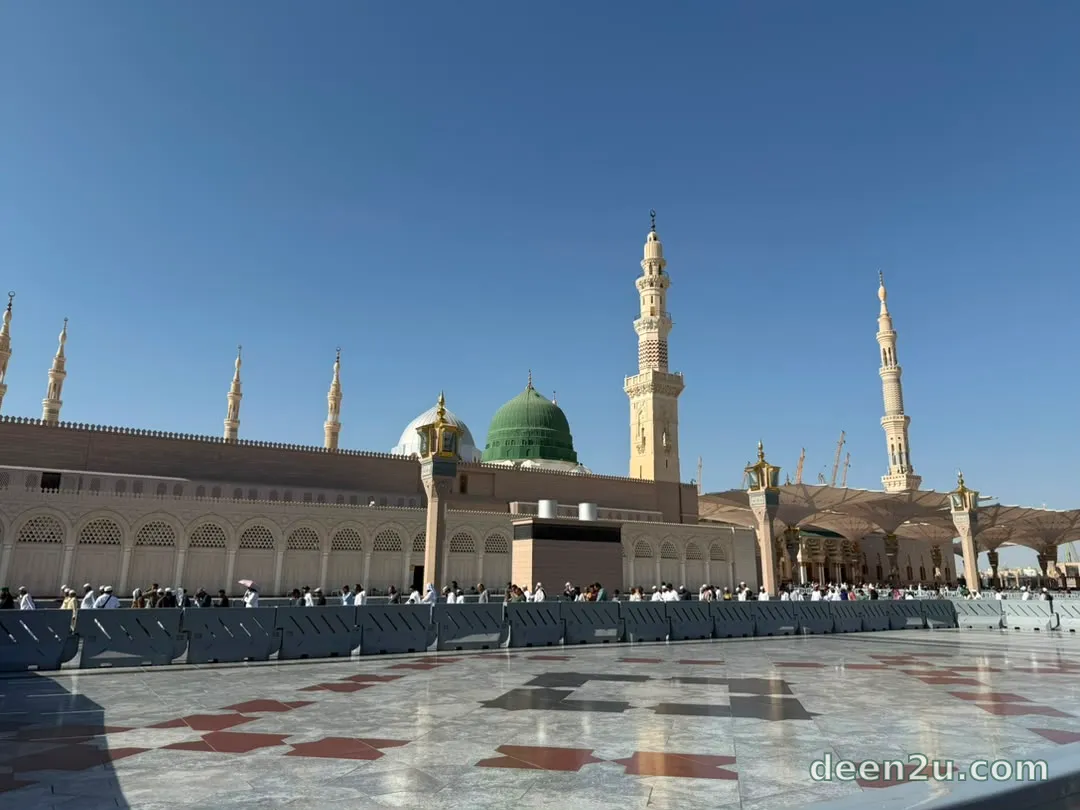
Al-Qubbah al-Khadra — the Green Dome, built above the Prophet's ﷺ resting place, seen from Masjid an-Nabawi's courtyard.
Masjid an-Nabawi is also one of only three mosques on earth to which a dedicated religious journey may be set out. The Prophet ﷺ said: "Do not set out on a journey except for three Mosques i.e. Al-Masjid-Al-Haram, the Mosque of Allah's Messenger ﷺ, and the Mosque of Al-Aqsa, (Mosque of Jerusalem)" (Sahih al-Bukhari 1189). Scholars draw a careful distinction around visiting his ﷺ grave: all four madhhabs regard greeting the Prophet ﷺ there as recommended for whoever is already in Madinah, but they differ on the traveller's intention. Ibn Taymiyyah and those who follow him held the journey itself should be intended for the mosque and its prayer, with the grave visit following naturally; many Shafi'i, Maliki, Hanafi, and Hanbali scholars — al-Nawawi among them — allowed intending the visit itself. In practice the pilgrim does both: pray in the mosque, then give salam at the grave with the same etiquette as any grave visit.
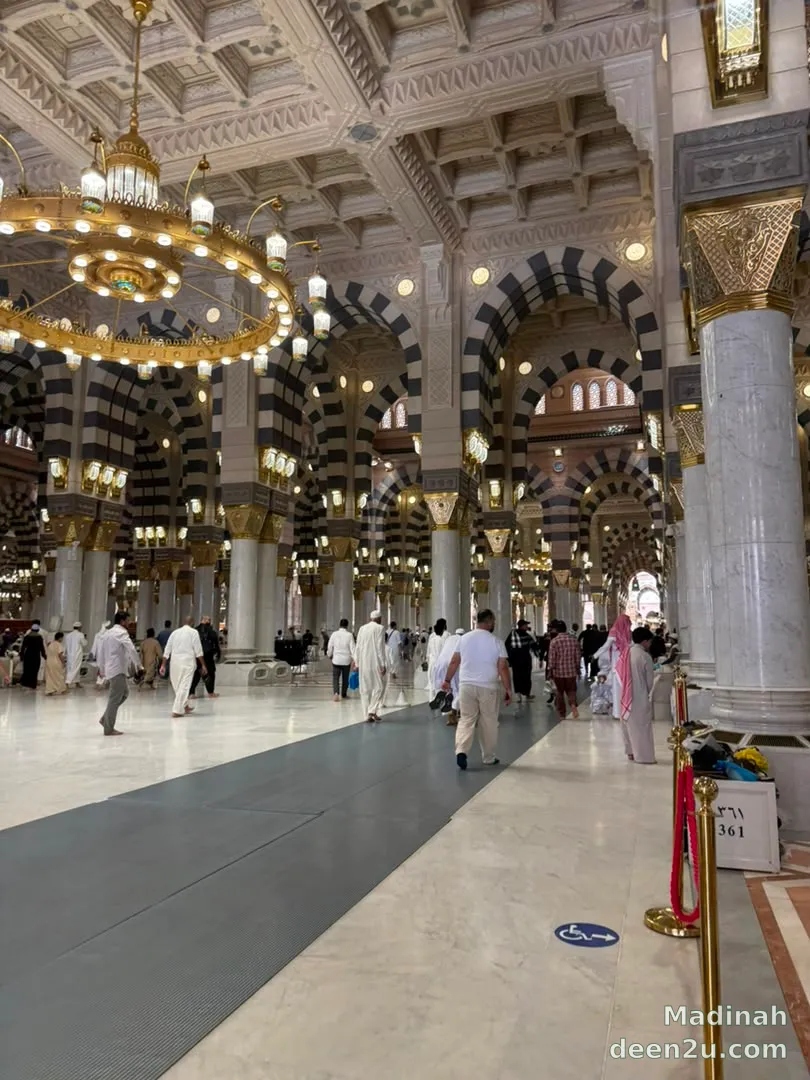
Inside Masjid an-Nabawi — the Prophet's ﷺ Mosque, the second holiest site in Islam and one of the three to which a journey may be set out.
Inside the mosque, the area between the Prophet's ﷺ former house (now his grave) and his minbar (pulpit) is known as Ar-Rawdah ("the garden") — a small, densely-visited space many pilgrims try to pray in specifically:
The gates of Masjid an-Nabawī — and the story of their names
In the Prophet's ﷺ day the mosque was a simple enclosure with only a few doors; today, after centuries of expansion, Masjid an-Nabawī has more than forty numbered gates. A handful of the historic names each carry a story from the Sunnah.
Bāb Jibrīl — the Gate of Gabriel
On the eastern side, beside ʿĀʾishah's apartment, was the door the Prophet ﷺ himself used to enter by — and through which the angel Jibrīl came to him. After the Battle of the Trench, when the Prophet ﷺ had laid down his arms, Jibrīl came to him through this door, the dust of battle still upon him, urging him on to Banū Qurayẓah (Sahih al-Bukhari 4117). It was formerly called Bāb an-Nabī and Bāb ʿUthmān.
Bāb an-Nisāʾ — the Women's Gate
This eastern door was set aside for the women by ʿUmar ibn al-Khaṭṭāb. Ibn ʿUmar related that ʿUmar said, "We should leave this door for the women" — and out of respect for his father's wish, Ibn ʿUmar never again entered through it until he died (Sunan Abī Dāwūd 571, sahih).
Bāb ar-Raḥmah — the Gate of Mercy
On the western side stands the Gate of Mercy (also called Bāb al-ʿĀtikah). Its name recalls the two Fridays of the rain-prayer: a bedouin entered through this very door during the Friday khuṭbah and asked the Prophet ﷺ to pray for rain; the rain fell for a week until, the next Friday, a man entered again to ask that it be lifted (Sahih al-Bukhari 1013–1014). The mercy is the rain that came at his ﷺ duʿāʾ.
Bāb as-Salām — the Gate of Peace
Also on the western side, Bāb as-Salām is the gate by which visitors have long entered to send their greetings (salām) upon the Prophet ﷺ. Near it once stood the house of Abū Bakr aṣ-Ṣiddīq.
The khawkhah of Abū Bakr
One door is tied to the noblest of the Companions. In his final illness the Prophet ﷺ ordered that every private side-door (khawkhah) opening from the houses into the mosque be closed, save one:
The scholars understood it as a sign of Abū Bakr's rank and his coming khilāfah. Today, gates named for Abū Bakr, ʿUmar and ʿUthmān, for Companions such as Bilāl and Abū Dharr, and for places such as al-Baqīʿ (facing the cemetery) and Qubāʾ, stand alongside the great modern gates named for the kings who expanded the mosque — but these older names still carry the Sunnah.
Like Makkah, Madinah is a declared sanctuary (haram) — the Prophet ﷺ fixed its boundaries and forbade bloodshed, cutting its trees, and hunting within them. And two protections were promised to the city itself:
Hadith — a sanctuary between its two mountains
"Narrated Anas:The Prophet (ﷺ) said, "Medina is a sanctuary from that place to that. Its trees should not be cut and no heresy should be innovated nor any sin should be committed in it, and whoever innovates in it an heresy or commits sins (bad deeds), then he will incur the curse of Allah, the angels, and all the people." (See Hadith No. 409, Vol)"
"Narrated Abu Huraira:Allah's Messenger (ﷺ) said, "There are angels guarding the entrances (or roads) of Medina, neither plague nor Ad-Dajjal will be able to enter it"
Life in Madinah was never promised to be easy — its heat, its scarcity — and the Prophet ﷺ attached a specific reward to bearing it: "No one will endure the hardships of Madinah without my being an intercessor or a witness on his behalf on the Day of Resurrection" (Sahih Muslim 1374a). He ﷺ went further for those able to remain until the end: "Whoever is able to die in Al-Madinah, then let him die there, for I will intercede for those who die there" (Jami' at-Tirmidhi 3917, graded hasan sahih gharib by at-Tirmidhi and sahih by al-Albani). None of this makes settling in Madinah obligatory — but it explains why, fourteen centuries on, so many hearts still ask to end their story in the Prophet's ﷺ city.
The mosques of Madinah
Beyond Masjid an-Nabawi, several smaller mosques across the city each mark a specific moment from the Prophet's ﷺ life or the earliest history of Islam.
First mosque in Islam
Masjid Quba
Built in the days right after the Hijrah, before the Prophet ﷺ had even completed the journey into the city proper — the first mosque founded in Islam. Most commentators read the Quran's description of "a mosque founded on righteousness from the first day" as referring to Quba (a minority hold it describes Masjid an-Nabawi instead). The Prophet ﷺ used to visit it regularly, on foot or riding, and prayed two rak'ahs each time.
Quran 9:108 · reward like an Umrah for praying there after purifying at home: Sunan Ibn Majah 1412 — sahih (al-Albani)
Where the qiblah changed
Masjid al-Qiblatain
"The Mosque of the Two Qiblahs." Muslims prayed facing Jerusalem for over a year after the Hijrah; mid-prayer at this mosque, the command came to turn instead toward the Kaaba in Makkah — the congregation is remembered as physically turning around in the middle of the rak'ah. The mosque's original architecture reflected both directions; today it's built and oriented toward Makkah alone.
Quran 2:144
Battle of the Trench
Masajid al-Sab'ah (the Seven Mosques)
A cluster of small mosques marking, by long-standing local tradition, the area where companions were stationed during the Battle of the Trench (Khandaq) in 5 AH — see the Islamic History Timeline for the full account of the siege and the trench itself. The site markers reflect historical memory of the battle's location rather than a specific hadith naming each individual mosque.
Quran 33:9–27 covers the battle itself
A dua that was answered
Masjid al-Ijabah
Originally called Masjid Bani Mu'awiyah — renamed "al-Ijabah" ("the Response") for what happened there: the Prophet ﷺ asked Allah for three things on behalf of his ummah. Two were granted — that they not be destroyed by famine, and not by mass drowning. The third — that they be spared internal killing among themselves — was withheld.
Sahih Muslim 2890
A few other small mosques near Masjid an-Nabawi — Masjid al-Ghamamah ("Mosque of the Cloud," associated by tradition with the site of the istisqa rain-prayer, Sahih al-Bukhari 1033, and Eid prayers at the open musalla, Sahih al-Bukhari 956) and mosques bearing Abu Bakr's and Ali's names — mark real events and real companions, but their present-day building locations rest on later historical tradition rather than a hadith naming that specific spot. Worth visiting for the history; not sites with a prescribed ritual of their own.
The story of Masjid Qubāʾ — the first masjid of Islam
When the Prophet ﷺ emigrated from Makkah, he did not sweep straight into Madinah. He halted first at Qubāʾ, on the city's southern edge, among the clan of Banū ʿAmr ibn ʿAwf, and stayed with them for some days. There, with his own hands helping to carry the stones, he laid the foundation of the first masjid ever built in Islam — a building of palm-trunks and mud-brick that Allah Himself would praise in the Quran:
"A masjid founded upon righteousness (taqwā) from the first day is worthier for you to stand in. Within it are men who love to purify themselves — and Allah loves those who purify themselves."
Sūrat al-Tawbah 9:108 — most commentators: this describes Qubāʾ
When the Prophet ﷺ asked the people of Qubāʾ about the purity for which Allah had praised them, they mentioned that they followed stones with water in cleaning themselves (istinjāʾ) — and so a Sunnah of cleanliness was affirmed from that very verse (Sunan Abī Dāwūd 44 · Jāmiʿ al-Tirmidhī 3100). And the Prophet ﷺ set a standing reward for the masjid that would draw hearts to it ever after:
Hadith — two rakʿah at Qubāʾ, like an ʿumrah
"(Sahl) bin Hunaif said:"The Messenger of Allah (ﷺ) said: 'Whoever purifies himself in his house, then comes to the Quba' Mosque and offers one prayer therein, will have a reward like that for 'Umrah.""
Sunan Ibn Majah 1412 · Sunan al-Nasa'i 699 — sahih
He did not forget it once he had settled in the city. Throughout his years in Madinah he kept a gentle weekly appointment with Qubāʾ — every Saturday, sometimes walking, sometimes riding:
Hadith — the Saturday visits
"Narrated `Abdullah bin Dinar:Ibn `Umar said, "The Prophet (ﷺ) used to go to the Mosque of Quba every Saturday (sometimes) walking and (sometimes) riding." `Abdullah (Ibn `Umar) used to do the same"
Sahih al-Bukhari 1193 · Sahih Muslim 1399
The story of Masjid al-Qiblatayn — where the qiblah turned
For the first year and more after the Hijrah, the Muslims prayed facing Bayt al-Maqdis in Jerusalem — while the Prophet ﷺ kept turning his face toward the sky, longing for the qiblah of Ibrāhīm. Then the command came down:
"We have certainly seen the turning of your face toward the heaven, and We will surely turn you to a qiblah with which you will be pleased. So turn your face toward al-Masjid al-Haram. And wherever you [believers] are, turn your faces toward it."
The revelation did not wait for the next prayer — and neither did the Companions. The news went out through the city and reached a congregation while they were standing in prayer, and they turned as they were, mid-prayer, from Shām to the Kaʿbah:
"Narrated Ibn `Umar:While some people were offering Fajr prayer at Quba mosque, someone came to them and said, "Qur'anic literature" has been revealed to Allah's Messenger (ﷺ) tonight, and he has been ordered to face the Ka`ba (of Mecca) so you too, should turn your faces towards it. Their faces were then towards Sham (Jerusalem), so they turned towards the Qibla (i.e. Ka`ba of Mecca)"
One prayer, two qiblahs in a single rakʿah — and no hesitation in between. The ṣaḥīḥ report above records the congregation at Qubāʾ; that the mosque of Banū Salamah in the city's west also witnessed the turning — and so carries the name Masjid al-Qiblatayn, "the Mosque of the Two Qiblahs," to this day — rests on Madinah's historical tradition, like the other site-markers noted above. What is beyond doubt is the lesson: the moment Allah's command reached them, they obeyed — without even finishing the prayer facing the old direction first. The qiblah change is one of the events that shaped Islamic practice for every Muslim who has faced the Kaʿbah since.
Jabal Uhud
The mountain just north of Madinah where the second major battle of the Prophet's ﷺ life was fought, a year after Badr — see the Islamic History Timeline for the full account: the archers who left their post, the reversal it caused, and the roughly seventy companions martyred, including the Prophet's ﷺ uncle Hamzah ibn Abd al-Muttalib. What makes Uhud distinct today isn't only its history — it's how the Prophet ﷺ himself spoke of the mountain:
Hadith — sahih
"When the mountain of Uhud appeared before Allah's Messenger ﷺ he said, "This IS a mountain that loves us and is loved by us."
The battle itself was costly: seventy of the Ansar were martyred (Sahih al-Bukhari 4078), and the Prophet ﷺ was himself wounded in the face, losing a tooth (Sahih al-Bukhari 5722). Anas ibn Malik narrated: "The Prophet ﷺ once climbed the mountain of Uhud with Abu Bakr, `Umar and `Uthman. The mountain shook with them. The Prophet ﷺ said (to the mountain), "Be firm, O Uhud! For on you there are no more than a Prophet, a Siddiq and two martyrs" (Sahih al-Bukhari 3675) — a striking word for a mountain, and part of why Uhud is remembered as more than a battlefield. The martyrs' graveyard at its foot, where Hamzah and the other companions who fell that day are buried, remains a site of quiet visitation — the same etiquette applies as any grave visit: dua for the deceased, not directed to them (see Visiting Graves for the full guidance on what's prescribed and what isn't).
Timeline of the Prophet ﷺ in Madinah
A compact chronology of the ten years between the Hijrah and the Prophet's ﷺ death — each entry links to the full Islamic History Timeline for the complete account and citations.
622 CE · 1 AH
The Hijrah
The Prophet ﷺ and his companions migrate from Makkah to Yathrib, which becomes Madinah — year 1 of the Islamic calendar.
622 CE · 1 AH
The Constitution of Madinah
An agreement establishing the rights and responsibilities of Madinah's Muslim, Jewish, and pagan tribes as one political community — among the earliest written constitutions in history, preserved through the biographical (seerah) literature.
624 CE · 2 AH
Battle of Badr
The first major battle, fought near the wells of Badr — a heavily outnumbered Muslim force secures a decisive victory, the turning point that secured the young Madinan state.
625 CE · 3 AH
Battle of Uhud
Fought at the mountain above — see the section above and the full Timeline for the complete account.
627 CE · 5 AH
Battle of the Trench (Khandaq)
A large confederation besieges Madinah; a defensive trench, suggested by the companion Salman al-Farisi, neutralizes their cavalry, and the siege collapses after roughly three weeks.
628 CE · 6 AH
Treaty of Hudaybiyyah
A ten-year truce with Quraysh, agreed short of Makkah — outwardly a concession, described in the Quran as a clear victory.
630 CE · 8 AH
Conquest of Makkah
The Prophet ﷺ returns to Makkah peacefully, and the Kaaba's idols are removed — see the Jahiliyyah section for that day's significance.
632 CE · 10 AH
The Farewell Pilgrimage & Sermon
The Prophet's ﷺ only Hajj, and his final address to the Muslim community — see the Farewell Sermon section on the Practice page for the sermon itself, cited line by line.
632 CE · 11 AH
The Prophet's ﷺ death and burial
He ﷺ passed away in Madinah and was buried where he died, in Aisha's ﵂ house adjoining the mosque — now enclosed within Masjid an-Nabawi itself, beneath the green dome.
Visiting Madinah
Visiting Madinah isn't a pillar of Islam and isn't a rite of Hajj or Umrah itself — but many pilgrims extend their trip to include it, given its history and the reward of praying in Masjid an-Nabawi. For a practical, step-by-step guide to what to see and how to plan the visit — including Masjid Quba, Jannat al-Baqi, and the other significant sites in the city — see the Ziarah guide on the DIY Umrah page.
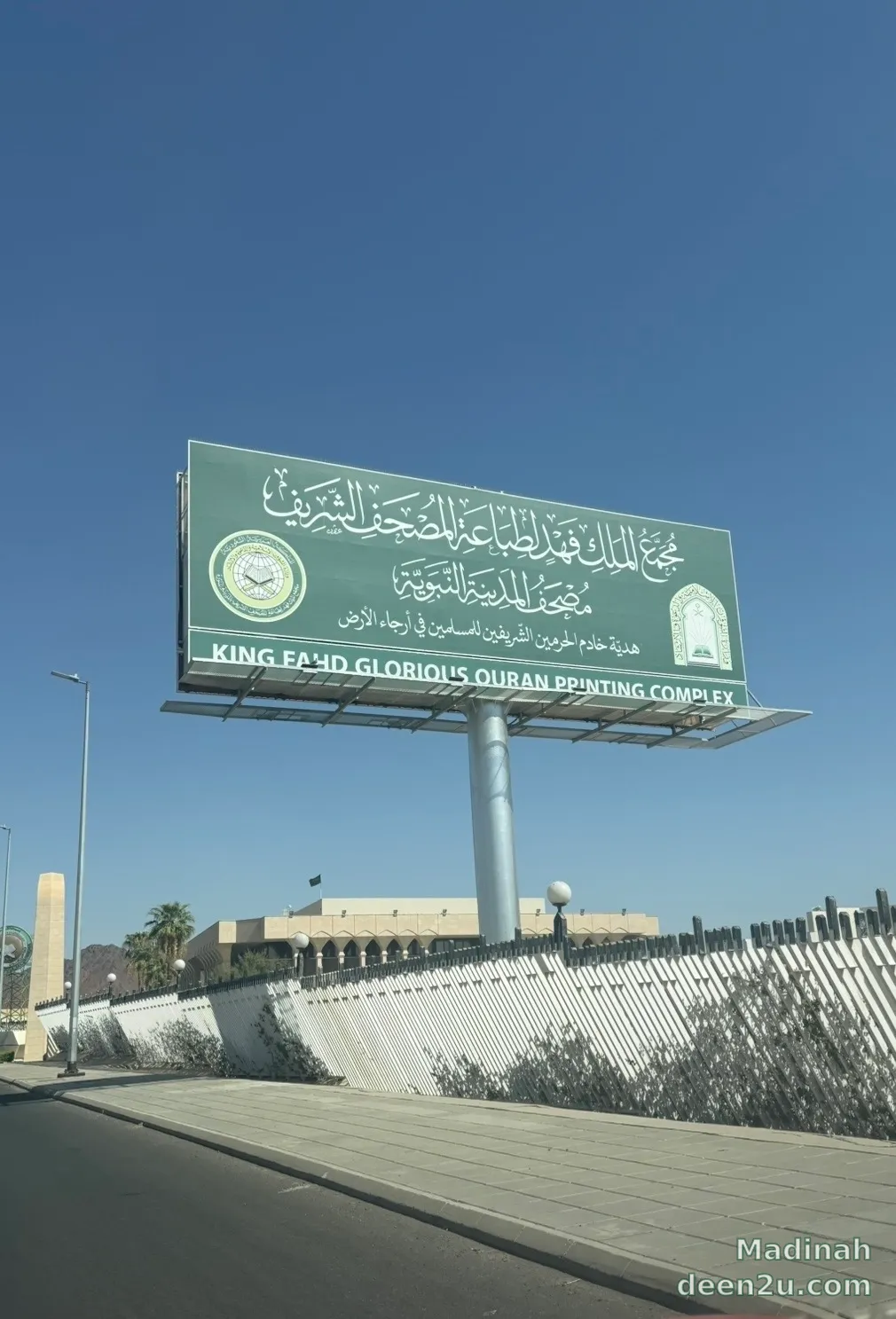
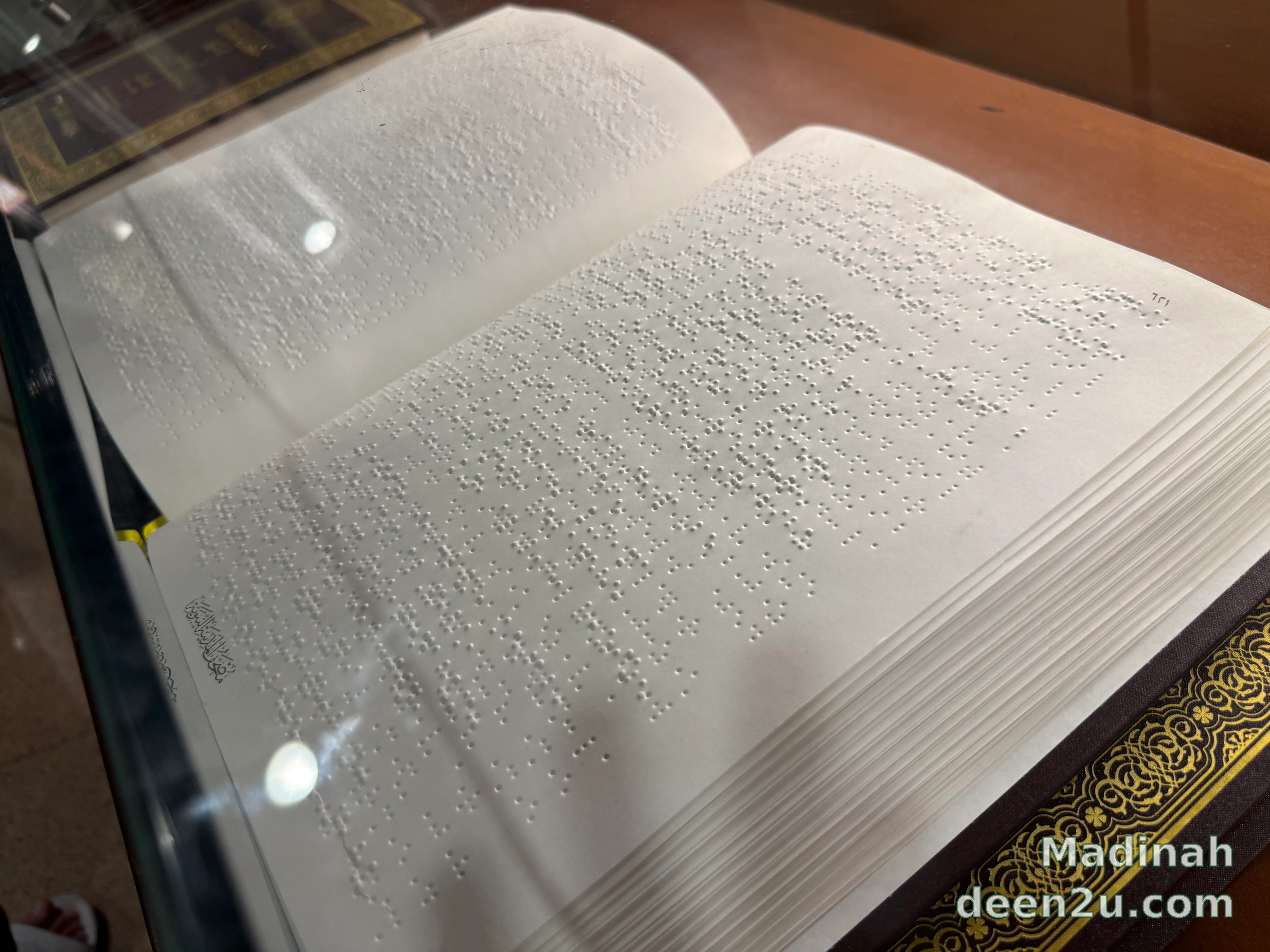
Madinah is also home to the King Fahd Complex for the Printing of the Holy Quran, one of the largest Quran printing houses in the world. It produces the Mushaf al-Madinah — the widely-used Uthmani print handed to pilgrims — along with translations, recordings, and Braille editions, distributed by the millions each year so the Book of Allah reaches every corner of the earth.
The King Fahd Complex for the Printing of the Holy Quran, Madinah — which produces the Mushaf al-Madinah distributed to pilgrims worldwide.A Braille copy of the Quran from the Complex — the Book is printed in Braille and many languages so it reaches everyone, including the blind.
This page covers Madinah's history and significance; practical visiting logistics (what to bring, timing, etiquette at each site) are on the DIY Umrah & Ziarah Guide to avoid repeating the same content twice.
Share this page as a poster
A 1080×1920 image made for phone screens — Stories, Status, Reels. It carries the
heading and the link back here, so whoever you send it to can read the whole thing.