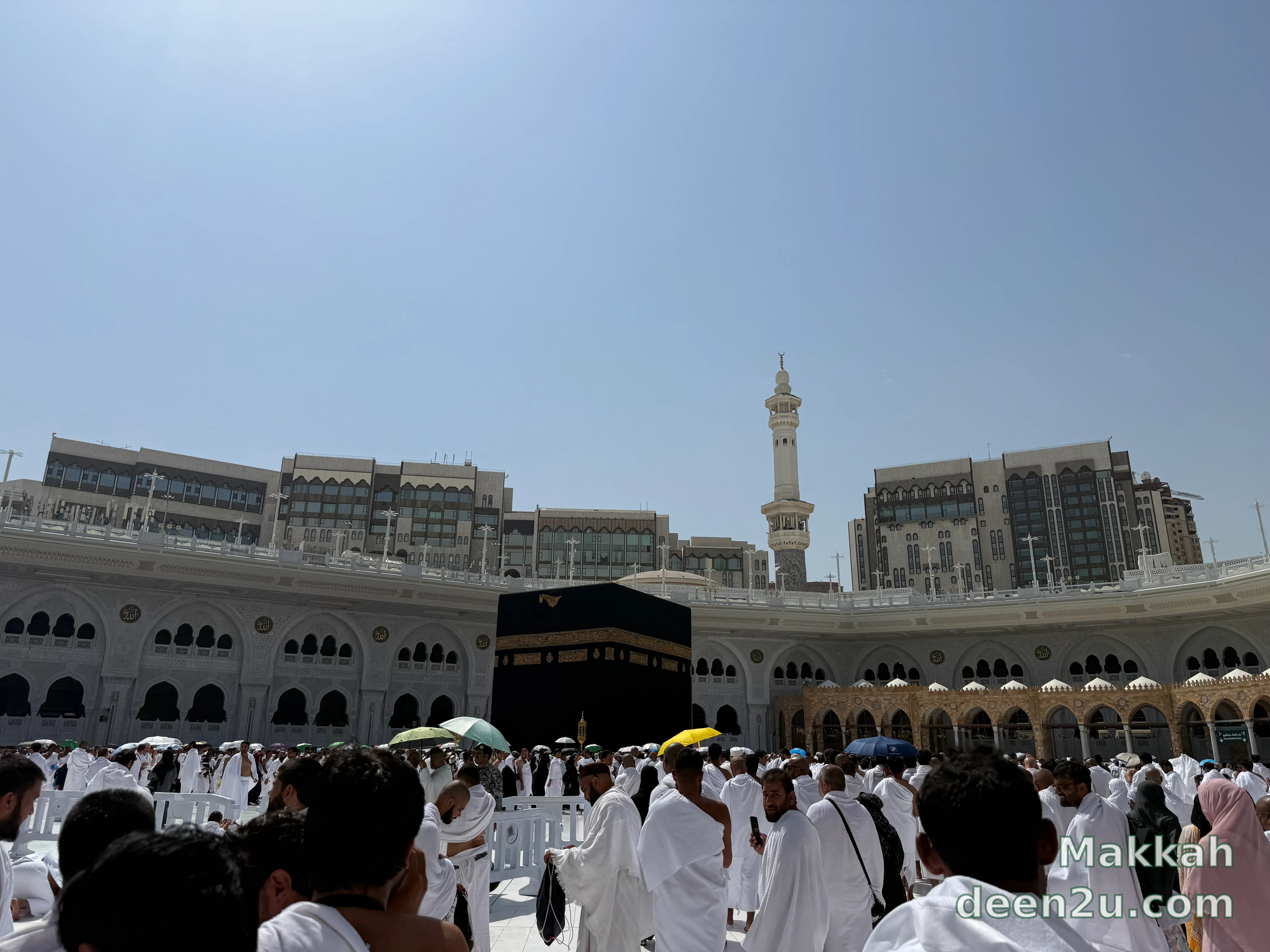
Masjid al-Haram — the Sacred Mosque in Makkah that surrounds the Kaaba, the goal of every pilgrim. Photo: deen2u
Where Makkah is, and why it matters
Makkah sits in a narrow valley in the Hejaz region of western Saudi Arabia, about 340 km (210 miles) south of Madinah in a straight line — about 450 km by the actual road — and roughly 70 km inland from the Red Sea coast. At its center is the Kaaba, inside Masjid al-Haram — the qiblah every Muslim faces in every prayer, everywhere on earth, and the destination of Hajj and Umrah. The Quran also calls it Umm al-Qura, "the Mother of Cities/Settlements" (Quran 6:92, 42:7) — a name reflecting both its ancient standing as the region's central settlement and its unmatched place in Islam.
"Bakkah" is the name the Quran itself uses here — most commentators take it as an older name for Makkah, or the name of the sacred area immediately around the Kaaba specifically. The Kaaba's construction, in its form known today, is tied to Ibrahim and his son Ismail:
"And [mention] when Abraham was raising the foundations of the House and [with him] Ishmael, [saying], 'Our Lord, accept [this] from us. Indeed You are the Hearing, the Knowing.'"
See the full account in the story of Ibrahim. The Kaaba they raised has been rebuilt and repaired several times since — after flood damage, and once during the Prophet's ﷺ own lifetime before his prophethood — but the location and the basic form have remained the same.
The discovery of Zamzam
Before the Kaaba was raised, the valley was already marked by another miracle. Ibrahim left his wife Hajar and their infant son Ismail here, by Allah's command, with a waterskin, a pouch of dates, and nothing else in any direction — praying as he walked away that Allah would settle his family "in an uncultivated valley near Your sacred House" (Quran 14:37). When the water ran out and the infant cried with thirst, Hajar ran between the two nearby hills, as-Safa and al-Marwah, searching for help — seven times back and forth, the very distance every pilgrim retraces today in sa'i. On the seventh crossing, water broke through the ground at the infant's feet. The Prophet ﷺ later described what she did next:
Hadith — "may Allah have mercy on the mother of Ismail"
"May Allah bestow Mercy on Ishmael's mother! Had she let the Zamzam (flow without trying to control it) (or had she not scooped from that water) (to fill her water-skin), Zamzam would have been a stream flowing on the surface of the earth."
Birds circling the new water drew the tribe of Jurhum to settle beside it — the beginning of Makkah as a place people actually lived, not just visited. Ismail grew up, married, and lived among them, and it was here, around this well, that he and his father later raised the Kaaba's walls. Generations afterward the well was lost, filled in and forgotten, until the Prophet's ﷺ own grandfather Abd al-Muttalib rediscovered it after being directed to its location in a dream — the rediscovery that made him the most honored man in Makkah, and put the office of watering the pilgrims (siqayah) in his family, still remembered in the Quran itself (9:19). Full account, sources, and what makes the water distinctive: The Well of Zamzam →
Timeline of Makkah
The Prophet's ﷺ own life in Makkah, before the Hijrah — each entry links to the fuller account elsewhere on the site.
c. 570 CE
Year of the Elephant & the Prophet's ﷺ birth
Muhammad ibn Abdullah is born in Makkah, in the same year the Abyssinian governor Abraha's march on the Kaaba with war elephants failed — the episode referenced in Surah al-Fil (Quran 105). See the Islamic History Timeline for the full account.
610 CE
First revelation, Cave of Hira
At Jabal al-Nur just outside Makkah, the angel Jibril brings the first revelation — "Iqra'" (Quran 96:1–5) — the start of the Quran and the Prophet's ﷺ mission.
613 CE
Public preaching begins
After three years of quiet invitation, the Prophet ﷺ ascends Mount Safa and calls Quraysh together openly — the start of public opposition to his message.
c. 616–619 CE
The boycott of Banu Hashim
Quraysh impose a social and economic boycott on the Prophet's ﷺ own clan for their protection of him, confining them to a mountain quarter (Shi'b Abi Talib) for roughly three years, until the boycott document was set aside and the siege lifted (seerah accounts).
c. 620–621 CE
Isra and Mi'raj
In a single night, the Prophet ﷺ is taken from Masjid al-Haram to Masjid al-Aqsa and ascends through the heavens — see the dedicated Isra & Mi'raj page for the full journey.
622 CE · 1 AH
The Hijrah — departure from Makkah
Facing an assassination plot, the Prophet ﷺ and Abu Bakr leave Makkah for Madinah — see Madinah's timeline for what follows.
630 CE · 8 AH
Conquest of Makkah
The Prophet ﷺ returns peacefully, and the 360 idols around the Kaaba are removed by hand — see the Jahiliyyah section for that day's full significance.
632 CE · 10 AH
The Farewell Pilgrimage
The Prophet's ﷺ only Hajj, performed here months before his death — see the Farewell Sermon on the Practice page, cited line by line.
Prayer in Masjid al-Haram
A prayer here carries the greatest reward of any mosque in the world — greater even than the Prophet's own mosque in Madinah:
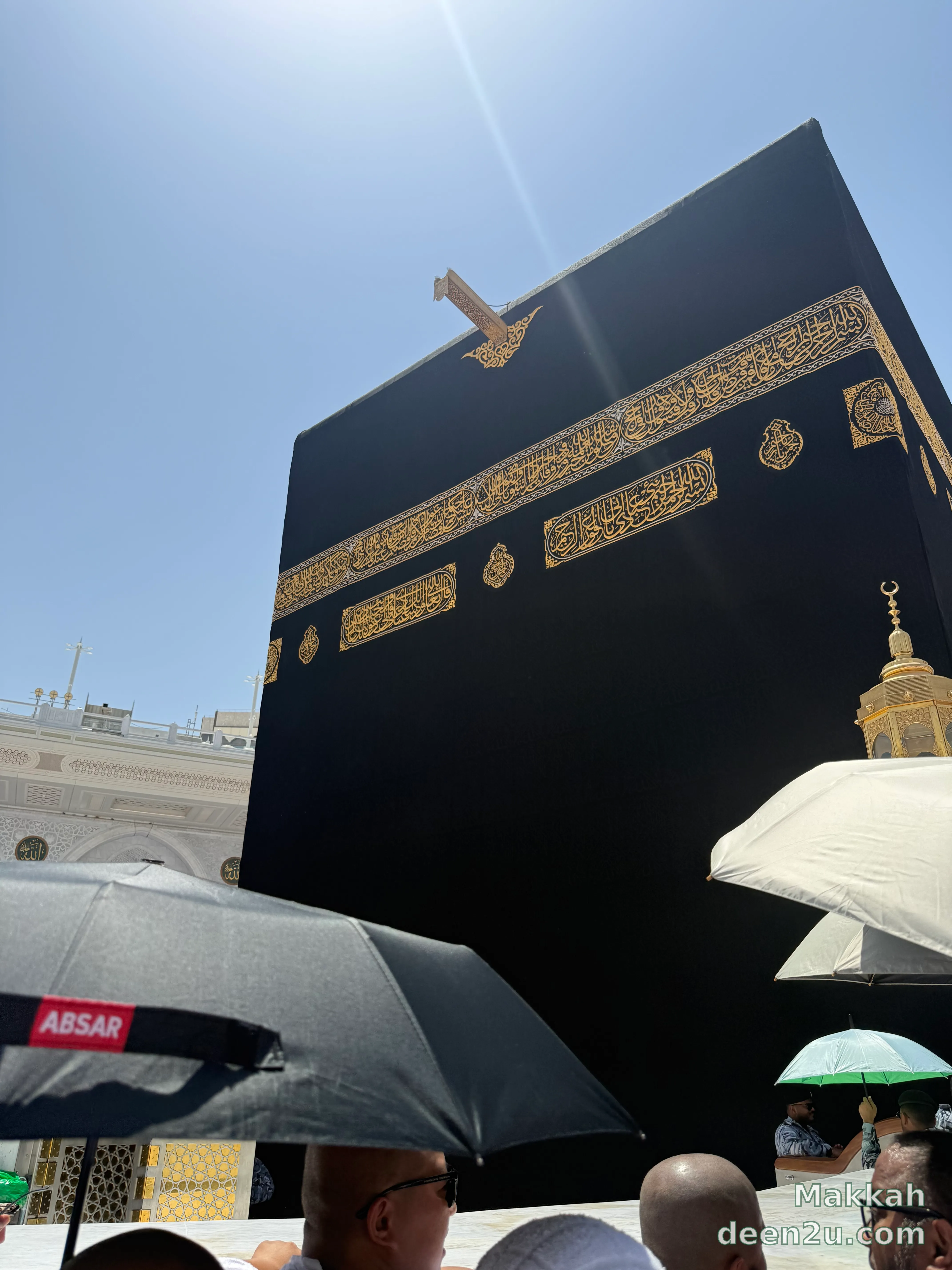
The Kaaba — the first House of worship built for mankind, and the qiblah every Muslim faces in prayer. Photo: deen2u
"One prayer in my mosque is better than one thousand prayers elsewhere, except the Sacred Mosque; and one prayer in the Sacred Mosque is better than one hundred thousand prayers elsewhere."
Sunan Ibn Majah 1406
Hadith — sacred since the day the heavens and earth were created
"No doubt, Allah has made this place (Mecca) a sanctuary since the creation of the heavens and the earth and will remain a sanctuary till the Day of Resurrection as Allah has ordained its sanctity. … Its thorns should not be uprooted and its game should not be chased."
Not to scale — approximate relative positions for orientation only.
1
Hajar al-Aswad (Black Stone)
Set into the Kaaba's eastern corner — the start and end point of every circuit of tawaf.
2
Hijr Ismail
The low, crescent-shaped wall on the Kaaba's northwest side. Widely held to be part of the original structure — praying inside it counts as praying inside the Kaaba, though it isn't part of the tawaf path itself (tawaf goes around it).
3
Multazam
The wall section between the Black Stone and the Kaaba's door — a spot where many pilgrims linger for dua when the crowd allows.
4
Maqam Ibrahim
A stone bearing a footprint impression, traditionally where Ibrahim stood while building the Kaaba. After tawaf, it's sunnah to pray two rak'ahs near it if space allows (see the Umrah guide for the full sequence).
5
Zamzam
The well that sprang for Hajar and the infant Ismail — full story above, and the complete account at The Well of Zamzam. Its water is provided throughout the mosque today via modern distribution, not drawn directly from the well itself.
6
Safa and Marwah (Mas'a)
The two hills connected by the covered walkway used for Sa'i — the seven-trip walk that's part of both Hajj and Umrah. Full details on the Umrah guide.
Why the Hijr Ismail sits outside the Kaaba
The low semicircle isn’t decorative — it marks a piece of the original Kaaba that no longer sits within the walls. When the Quraysh rebuilt the Kaaba in the Prophet’s ﷺ youth (after a flood had weakened it), they ran short of lawful (halal) funds to complete it on Ibrahim’s full foundations, so they shortened the building and walled off part of the original floor plan. That excluded arc — the Hijr (also called al-Hatim) — is therefore part of Ibrahim’s Kaaba, which is why praying inside it counts as praying inside the Kaaba, and why tawaf must pass around it, never through. Aisha (رضي الله عنها) reported the Prophet’s ﷺ own words:
Hadith — sahih, agreed upon
“Do you know that when your people (Quraish) rebuilt the Ka`ba, they decreased it from its original foundation laid by Abraham? … Were it not for the fact that your people are close to the Pre-Islamic Period of ignorance (i.e. they have recently become Muslims) I would have done so.”
He ﷺ left it as the people knew it to avoid unsettling hearts still new to faith — a quiet lesson in weighing a good against the greater harm of causing confusion over a lesser matter.
What Maqam Ibrahim actually is
It is not a grave, a shrine, or an object of worship — it is a stone that Ibrahim ﷺ stood upon. As he and his son Ismail raised the Kaaba’s walls, the stone served as his standing-place; the reports describe his footprints preserved in it, and connect it to where he stood to call mankind to the pilgrimage. Allah made it a sign of the sanctuary and a place of prayer:
Qur’an — the station of Ibrahim
وَاتَّخِذُوا مِن مَّقَامِ إِبْرَاهِيمَ مُصَلًّى
“And take the station of Ibrahim as a place of prayer.” And elsewhere the sanctuary is described: “In it are clear signs — the station of Ibrahim.”
Today the stone rests in a small glass-and-brass enclosure a few metres from the Kaaba’s door. After finishing tawaf it is sunnah to pray two rak’ah behind it — “behind” only in position: the prayer is to Allah alone, and the footprints are honoured as a trace of Ibrahim’s obedience, never venerated in themselves — the very tawhid that cleared the 360 idols from around this House.
Kissing the Black Stone is a beloved sunnah — and Islam is emphatic about what the act is not. Umar ibn al-Khattab kissed it and then declared before the pilgrims:
Hadith — "I know that you are a stone"
"No doubt, I know that you are a stone and can neither benefit anyone nor harm anyone. Had I not seen Allah's Messenger ﷺ kissing you I would not have kissed you."
Sahih al-Bukhari 1597
The gesture is pure following of the Prophet ﷺ, not veneration of an object — the same tawhid that removed 360 idols from around the Kaaba governs how the Stone itself is approached. When the crowd makes kissing impossible, it is enough to gesture toward the corner from a distance as each circuit passes; no one should push or harm others to reach it.
The Kiswah, and how the mosque itself has grown
Two things change year to year even though the Kaaba's location and form never have: the cloth that covers it, and the size of the mosque built up around it.
The Kiswah
The Kaaba's black silk covering, re-made and replaced every year — for decades on the 9th of Dhul-Hijjah (the Day of Arafah), and since 1444 AH (July 2022) on the 1st of Muharram, marking the Islamic New Year. A gold-and-silver-embroidered band near the top carries Quranic calligraphy, and a wider belt of verses runs around the middle. It's produced year-round at a dedicated complex in Makkah built specifically for this purpose, using several hundred kilograms of silk and specialized thread.
A tradition older than Islam
Covering the Kaaba wasn't started by Islam — pre-Islamic Quraysh already draped it in cloth, a practice the Prophet ﷺ and the early caliphs continued and later standardized, before the specific black silk design became fixed under the Abbasids and remained the norm since.
From a small courtyard to a vast complex
In the Prophet's ﷺ time, the area around the Kaaba was a modest open space. Successive rulers expanded it over the centuries — the Abbasids, the Ottomans, and, most dramatically, Saudi Arabia's series of expansions from the mid-20th century onward, which turned Masjid al-Haram into a multi-level complex covering hundreds of thousands of square meters, able to hold well over a million worshippers at once during peak times like Ramadan and Hajj.
What hasn't changed
Through every expansion, the Kaaba has stood in exactly the same place — though not at Ibrahim's full size: Quraysh's rebuild during the Prophet's ﷺ lifetime fell short of his foundations, leaving the Hijr's space outside the walls, and that footprint remains today. The mosque's growth has always been built outward and upward around the House, never by moving it.
The Kaaba, rebuilt more than once
The Kaaba has stood on the same spot since Ibrahim raised it — but its walls have fallen and risen more than once. When Quraysh rebuilt it during the Prophet's ﷺ young adulthood, their lawfully-earned funds ran short, so several cubits of Ibrahim's foundation were left outside the structure: the semicircular space of the Hijr. The Prophet ﷺ told Aisha he would have restored Ibrahim's full foundations himself, were it not that her people had so recently left ignorance (Sahih al-Bukhari 1583; Sahih Muslim 1333). Decades later, Abdullah ibn az-Zubayr did exactly that — extending the Kaaba over the Hijr, with two doors at ground level — before al-Hajjaj, under the Umayyads, returned it to Quraysh's footprint, the form it keeps today. This is also why the Hijr matters so much to pilgrims: praying inside it is praying within the House itself.
Masjid ʿĀʾishah (at-Tanʿīm) — and how many umrahs are Sunnah
Masjid ʿĀʾishah stands at at-Tanʿīm, about 7 km northwest of Masjid al-Haram, at the nearest point of the ḥill — the land just outside the sacred Ḥaram boundary. It is the mīqāt most used by those already in Makkah who wish to enter iḥrām for a fresh umrah, since one must go out to the ḥill to begin.
Its name comes from an incident on the Farewell Pilgrimage. ʿĀʾishah (ra) had entered iḥrām for umrah, but her menses came before she could perform ṭawāf, so the Prophet ﷺ told her to bring her umrah into her Hajj and perform every rite except ṭawāf until she was pure. When the Hajj was complete she grieved that the others had done a separate Hajj and a separate umrah while hers had been merged — so the Prophet ﷺ ordered her brother, ʿAbd ar-Raḥmān ibn Abī Bakr, to take her out to at-Tanʿīm to enter iḥrām for a fresh umrah, "in place of your umrah" (Sahih al-Bukhari 1786; Sahih Muslim 1211). The mosque marks that spot.
How many umrahs in one journey?
The Prophet ﷺ performed umrah four times in his life — every one of them on a separate journey, and all in the month of Dhul-Qaʿdah: the umrah of Ḥudaybiyyah (turned back), the umrah of al-Qaḍāʾ the following year, the umrah from al-Jiʿrānah, and the umrah joined with his Hajj (Sahih al-Bukhari 1778; Sahih Muslim 1253). On no single stay in Makkah did he leave again and again to the ḥill to perform umrah after umrah. ʿĀʾishah's umrah from at-Tanʿīm was a particular consolation for what her menses had cost her — not a standing encouragement to repeat umrah within one trip.
The verifying scholars — Ibn Taymiyyah, Ibn Bāz and Ibn ʿUthaymīn among them — held that repeatedly going out to at-Tanʿīm for several umrahs in one visit is not from the guidance of the Prophet ﷺ and his Companions. The better course is to make one umrah, then spend the remaining days in ṭawāf around the Kaʿbah, prayer, and worship at the Ḥaram — a number of the Salaf, such as Ibn ʿAbbās, considered ṭawāf superior to leaving for a repeated umrah. It is not sinful for one who does repeat it (some scholars permit it) — but leaving it is closer to the Sunnah.
This page covers Makkah's history and the layout of Masjid al-Haram; for how to actually perform tawaf, Sa'i, and the rest of Umrah step by step, see the DIY Umrah & Ziarah Guide — including the Ziarah sites around Makkah like Jabal al-Nour, Jabal Thawr, and Jannat al-Mu'alla.
Share this page as a poster
A 1080×1920 image made for phone screens — Stories, Status, Reels. It carries the
heading and the link back here, so whoever you send it to can read the whole thing.