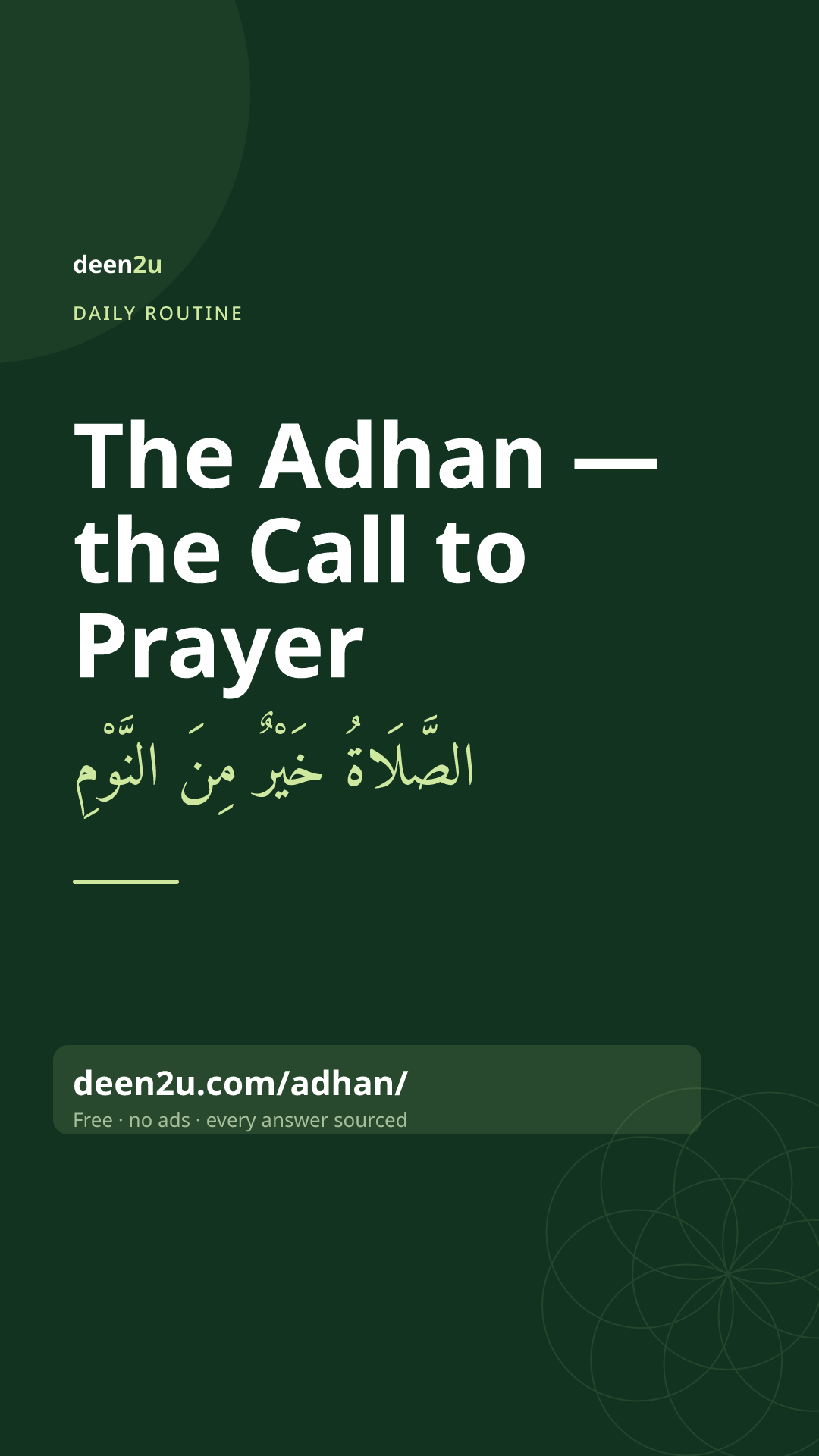
The Adhan — the Call to Prayer
Five times a day the whole of Islam is proclaimed aloud from the minaret. This page walks through every phrase of the adhan and iqamah, the true dream that gave them their words, the four schools' rulings, the Fajr tathwib, how to answer the muadhin, and the dua the Prophet ﷺ tied to his own intercession.
RulingSunnah mu'akkadah to fard kifayah — the schools differ
First muadhinBilal ibn Rabah — chosen for his voice
Its wordingTaught in a true dream, confirmed by the Prophet ﷺ
Fajr only"Prayer is better than sleep" — the tathwib
A gift for you
أذان
The Adhan
Free ebook · A gift from deen2u
This whole page, in one pocket book
The Complete Adhan Guide — the full wording of the call and the iqamah, its origin, the four schools' rulings and differences, the Fajr tathwib, and every response and dua the Sunnah teaches. An A5 guide with every citation verified against the collections hosted on this site.
- The adhan and iqamah, phrase by phrase with the Arabic
- The origin — Abdullah ibn Zayd's dream, confirmed by the Prophet ﷺ
- How to answer the muadhin, and the dua of al-Wasilah
- The madhhab differences, side by side, as valid variety
What the adhan and iqamah are
The adhan (الأذان) is the public call announcing that the time for an obligatory prayer has entered. Its root means "to announce" or "to make known" — and what it makes known is the heart of the religion: Allah's greatness, the two testimonies of faith, and a summons to prayer and to success. It is the sound of Islam spoken aloud over a city, and hearing it is, in effect, hearing the creed summarised five times a day.
The iqamah (الإقامة) is the second, quieter call given immediately before the congregation stands to pray. The word means "to establish" or "to stand up for prayer," and it carries one phrase the adhan does not: qad qamati as-salah — "the prayer is now established" — said twice. The two calls do different work: the adhan invites the wider community to gather from outside the mosque, while the iqamah tells those already present that the prayer is beginning and the rows should form.
The Prophet ﷺ set the rhythm of the two calls: the phrases of the adhan are pronounced in pairs (doubled), while the phrases of the iqamah are pronounced singly — except qad qamati as-salah, which is kept doubled.
Hadith — the shape of the two calls
"Narrated Anas:Bilal was ordered to repeat the wording of the Adhan for prayers twice, and to pronounce the wording of the Iqama once except "Qad-qamat-is-salat"
Narrated by Anas ibn Malik (رضي الله عنه) — Sahih al-Bukhari 605
The call was no minor custom on the edge of the community — the Quran names it and defends it. The Friday call is commanded in 62:9, and 5:58 rebukes those who mock the summons to prayer, which shows it was already a distinctive, public institution of the earliest Muslims.
Quran — the Friday call
يَا أَيُّهَا الَّذِينَ آمَنُوا إِذَا نُودِيَ لِلصَّلَاةِ مِن يَوْمِ الْجُمُعَةِ فَاسْعَوْا إِلَىٰ ذِكْرِ اللَّهِ
"O you who believe! When the call is proclaimed for the prayer on Friday, hasten to the remembrance of Allah and leave off business."
Quran 62:9
Quran — the call was already a public rite
وَإِذَا نَادَيْتُمْ إِلَى الصَّلَاةِ اتَّخَذُوهَا هُزُوًا وَلَعِبًا
"And when you call to prayer, they take it in ridicule and jest. That is because they are a people who do not reason."
Quran 5:58
The ruling: sunnah mu'akkadah or fard kifayah?
Every school agrees the adhan is a sha'irah — a hallmark and public sign of Islam — and a communal institution that a Muslim society may not simply let fall silent. But the schools genuinely differ on its precise legal weight, and this is a well-known disagreement that none of them settles against the others. The Prophet ﷺ ordered Bilal to give the call (Sahih al-Bukhari 604), and even instructed a small travelling group to raise it: "when it is the time for the prayer one of you should pronounce the Adhan and the oldest of you should lead the prayer" (Sahih al-Bukhari 631) — but the schools read the strength of that command differently.
| School | Classification of the adhan |
|---|
| Hanafi | Sunnah mu'akkadah — an emphatically confirmed Sunnah, strongly established and blameworthy for a community to neglect, though not termed an outright obligation. |
| Shafi'i | Sunnah mu'akkadah for the five daily prayers and Jumu'ah; some Shafi'i scholars hold it fard kifayah for a town where abandoning it would efface the sign of Islam. |
| Maliki | Wajib kifayah — a communal duty specifically in the congregational mosques of towns where Jumu'ah is held; a town abandoning it could be compelled to restore it. |
| Hanbali | Fard kifayah upon resident men in towns and villages for the five daily prayers; if some perform it, the duty lifts from the rest — but a whole town abandoning it sins together. |
Fard kifayah — a communal obligation — means the duty must be met somewhere in the community; once it is sufficiently fulfilled, the sin of omission falls from everyone else. That is why not every single mosque or household needs to raise the call for the duty to be discharged, yet a community with no call at all would be at fault. And the schools share a practical bottom line: for the individual praying alone or in a small group, giving the adhan and iqamah is a recommended Sunnah — highly encouraged even for one person, and even while travelling — but it is not a condition of the prayer's validity. If the calls are omitted, the prayer still stands.
The origin: a consultation and a true dream
After the migration to Madinah the Muslims would gather and estimate the prayer times by sight, but they had no agreed signal to summon everyone. So the community took counsel. Proposals were raised and set aside precisely because they resembled the marks of other faiths: a bell (naqus) like the Christians, a horn or trumpet like the Jews, and by some reports the lighting of a fire — each rejected so that the Muslims would have a call of their own. It was in that discussion that Umar ibn al-Khattab suggested appointing a man to call the people, and the Prophet ﷺ ordered Bilal to rise and give the call.
Hadith — how the call was chosen
"When the Muslims arrived at Madinah, they used to assemble for the prayer and guess the time for it… Some suggested a bell as the Christians do, others a trumpet like the horn of the Jews, but Umar was the first to suggest that a man should call for the prayer; so Allah's Messenger ﷺ ordered Bilal to get up and pronounce the adhan."
Narrated by Ibn Umar (رضي الله عنهما) — Sahih al-Bukhari 604
The specific wording came through a dream. Abdullah ibn Zayd al-Ansari related that as he slept, a man carrying a bell appeared to him; when Abdullah asked to buy it to summon people to prayer, the man said, "Shall I not show you something better than that?" — and taught him the words of the adhan and the iqamah. The next morning Abdullah told the Prophet ﷺ, who declared it a true vision (ru'ya haqq) and said, "Get up with Bilal and teach him, for he has a more resonant voice than you."
Hadith — the dream, and the words it carried hasan sahih
اللَّهُ أَكْبَرُ اللَّهُ أَكْبَرُ، اللَّهُ أَكْبَرُ اللَّهُ أَكْبَرُ، أَشْهَدُ أَنْ لاَ إِلَهَ إِلاَّ اللَّهُ، أَشْهَدُ أَنَّ مُحَمَّدًا رَسُولُ اللَّهِ، حَىَّ عَلَى الصَّلاَةِ، حَىَّ عَلَى الْفَلاَحِ، اللَّهُ أَكْبَرُ اللَّهُ أَكْبَرُ، لاَ إِلَهَ إِلاَّ اللَّهُ
"A man carrying a bell in his hand appeared to me while I was asleep, and I said; servant of 'abd Allah, will you sell the bell? He asked; what will you do with it? I replied; we shall use it to call the people to prayer. He said; should I not suggest you something better than that. I replied: certainly… When the morning came, I came to the Messenger of Allah ﷺ and informed him of what I had seen in the dream. He said: it is a genuine vision, and he then should use it to call people to prayer, for he has a louder voice than you have."
Narrated by Abdullah ibn Zayd — Sunan Abi Dawud 499; corroborated at Sunan Ibn Majah 706 (hasan) and Jami at-Tirmidhi 189
It is also related in the sira that Umar ibn al-Khattab had seen a matching vision and came to report it, which the Companions took as a further sign that the words were rightly guided — though it was the Prophet's ﷺ own confirmation, not the dream, that made the adhan law. (The report of Umar's matching vision is graded weak, so the strength of the case rests on Abdullah ibn Zayd's narration above and the Prophet's approval.) Bilal ibn Rabah, the freed Abyssinian companion chosen for his powerful, beautiful voice, thus became the first muadhin of Islam, calling from the highest rooftop near the Prophet's ﷺ mosque; Abdullah ibn Zayd, who had received the words, was given the honour of pronouncing the iqamah on that first occasion.Sunan Abi Dawud 512 There is a quiet theology in this: the call that gathers the whole ummah was first raised by a formerly enslaved man, because nearness to Allah rests on faith and devotion, not lineage.
The status of the muadhin and the virtue of the call
The Prophet ﷺ honoured those who carry the call with a striking image of the Day of Judgment.
Hadith — the highest station
الْمُؤَذِّنُونَ أَطْوَلُ النَّاسِ أَعْنَاقًا يَوْمَ الْقِيَامَةِ
"The muadhins will have the longest necks of all people on the Day of Resurrection."
Narrated by Mu'awiya ibn Abi Sufyan (رضي الله عنه) — Sahih Muslim 387
Scholars read "the longest necks" in several complementary ways. Al-Nawawi notes the Arabs described leaders and masters as "long-necked," so the phrase marks the muadhins out as foremost and most honoured; others say they will be the most eager, craning toward Allah's mercy; and some that their necks will be raised above the sweat and distress of that Day. The reward is not the caller's alone. The Prophet ﷺ taught that everything that hears the muadhin's voice — human, jinn, or anything else — will testify for him on the Day of Resurrection (Sahih al-Bukhari 609), and that the role is so coveted that "if the people knew the reward for pronouncing the adhan and for standing in the first row, and they could not get it except by drawing lots, they would do so" (Sahih al-Bukhari 615; Sahih Muslim 437).
Because the call is both a trust and an act of worship, the schools recommend that the muadhin be of good character, ritually pure, with a clear, far-reaching voice, and that he call for Allah's sake rather than for payment as his primary motive. And the listener shares in the blessing: it is Sunnah to repeat the words after him, to send salawat on the Prophet ﷺ, and to recite the dua that follows — so the reward of the call flows to caller and hearer alike.
The wording of the adhan, phrase by phrase
The adhan that most of the Muslim world uses runs, in order: Allahu akbar (four times), ashhadu an la ilaha illa Allah (twice), ashhadu anna Muhammadan rasul Allah (twice), hayya 'ala as-salah (twice), hayya 'ala al-falah (twice), Allahu akbar (twice), and la ilaha illa Allah (once) — fifteen utterances in all when the opening takbir is counted as four.
| Phrase | Meaning | Times |
|---|
| Allahu akbar | Allah is greatest | 4 |
| Ashhadu an la ilaha illa Allah | I bear witness there is no god but Allah | 2 |
| Ashhadu anna Muhammadan rasul Allah | I bear witness Muhammad is the Messenger of Allah | 2 |
| Hayya 'ala as-salah | Come to the prayer | 2 |
| Hayya 'ala al-falah | Come to success | 2 |
| Allahu akbar | Allah is greatest | 2 |
| La ilaha illa Allah | There is no god but Allah | 1 |
The whole call is framed between takbir and tahlil — it opens on Allah's supremacy above every claim on our attention (the same phrase that opens the prayer itself) and closes on pure monotheism. In between stand the two testimonies (shahadatayn), which proclaim the creed publicly, and the two summons — "come to the prayer," "come to success" — the only phrases at which the muadhin turns his head right and then left. The listener's recommended reply is to echo each phrase after the muadhin, with one exception at the two summons, covered in answering the muadhin below.
Hadith — the adhan is said in pairs
اللَّهُ أَكْبَرُ، أَشْهَدُ أَنْ لَا إِلَهَ إِلَّا اللَّهُ، أَشْهَدُ أَنَّ مُحَمَّدًا رَسُولُ اللَّهِ، حَيَّ عَلَى الصَّلَاةِ، حَيَّ عَلَى الْفَلَاحِ، اللَّهُ أَكْبَرُ، لَا إِلَهَ إِلَّا اللَّهُ
"Bilal was commanded to pronounce the wording of the adhan an even number of times and the iqamah an odd number of times."
Narrated by Anas ibn Malik (رضي الله عنه) — Sahih Muslim 378
The Sunnah of the listener attaches directly to this wording: "whoever among you hears the call, let him say the like of what the muadhin says, then send blessings upon me, then ask Allah for al-Wasilah for me" (Sahih Muslim 384, narrated by Abdullah ibn Amr ibn al-'As). The origin of these exact words, as above, is the dream of Abdullah ibn Zayd that the Prophet ﷺ confirmed and had Bilal proclaim (Sunan Abi Dawud 499).
The Fajr tathwib: "prayer is better than sleep"
For the dawn (Fajr) prayer only, an extra line — called the tathwib — is inserted after hayya 'ala al-falah and before the closing takbir: as-salatu khayrun min an-nawm, "prayer is better than sleep," said twice. It is a gentle, prophetically taught reminder fitted to the one prayer whose main obstacle is sleep. The Prophet ﷺ taught that "prayer is better than sleep" is said in the Fajr call, and it was the continuous practice of the two muezzins he appointed, Bilal and Abu Mahdhurah, and of Makkah and Madinah ever since. All four Sunni schools treat it as an established Sunnah of the Fajr adhan, not an innovation.
Hadith — the tathwib hasan
الصَّلَاةُ خَيْرٌ مِنَ النَّوْمِ
"Prayer is better than sleep, prayer is better than sleep… in the first (Adhan) for As-Subh (Fajr)."
Sunan an-Nasa'i 633 (the Abu Mahdhurah narration; also Sunan Abi Dawud 500–501)
Two points worth stating plainly. First, because these reports sit outside al-Bukhari and Muslim, honest citation includes their grade — the tathwib rests on the Abu Mahdhurah narration graded hasan, with parallels in the other Sunan collections. Second, the prevailing view (the Standing Committee and others) is that the tathwib belongs in the adhan called at the entry of Fajr time — the call for the prayer itself — and that any mention of a "first adhan" here means the first of the two calls relative to the iqamah, not a pre-dawn call given while it is still night. A minority historically debated whether the phrase was original wording or a later addition, but the mainstream conclusion is settled: its use is Sunnah, and it is said in no prayer but Fajr.
The iqamah and "qad qamati as-salah"
The iqamah is the second, quieter call, given immediately before the congregation stands. It uses essentially the same phrases as the adhan but adds one that is unique to it: qad qamati as-salah, "the prayer has now begun," said twice. The guiding principle in the hadith of Anas is that the adhan is "made even" (each phrase paired) while the iqamah is "made odd" (each phrase single) — with the standing exception of qad qamati as-salah, which is kept at two.
Hadith — the iqamah is singled, but for one phrase
أُمِرَ بِلَالٌ أَنْ يَشْفَعَ الْأَذَانَ وَيُوتِرَ الْإِقَامَةَ إِلَّا الْإِقَامَةَ
"Bilal was ordered to repeat the wording of the Adhan for prayers twice, and to pronounce the wording of the Iqama once except "Qad-qamat-is-salat"
Narrated by Anas ibn Malik (رضي الله عنه) — Sahih al-Bukhari 605; parallel at Sahih Muslim 378
In the majority (Shafi'i and Hanbali) form, the full iqamah is eleven utterances: Allahu akbar (twice), ashhadu an la ilaha illa Allah (once), ashhadu anna Muhammadan rasul Allah (once), hayya 'ala as-salah (once), hayya 'ala al-falah (once), qad qamati as-salah (twice), Allahu akbar (twice), la ilaha illa Allah (once). No school disputes that the iqamah is legislated or that qad qamati as-salah belongs to it; the differences, below, are only about how many times the phrases are repeated. One reported reply to hearing qad qamati as-salah — aqamaha Allahu wa adamaha, "may Allah establish it and make it lasting" — rests on a weak chain and its ruling is debated, so many scholars simply advise repeating the words like the rest of the iqamah.
Genuine madhhab differences — valid variety, not error
Some of the most visible differences between Muslim communities are heard in the call itself. These are not contradictions in the religion but different authentic Sunnahs that the Prophet ﷺ taught to different Companions — chiefly Bilal in Madinah and Abu Mahdhurah in Makkah. The scholars agree that praying behind a muezzin of any school is completely valid, and a Muslim travelling between lands will simply hear the local form.
| Feature | Hanafi | Shafi'i | Maliki | Hanbali |
|---|
| Opening takbir | ×4 | ×4 | ×2 | ×4 |
| Tarji' (testimonies said quietly, then aloud) | No | Yes | Yes | No |
| Iqamah phrases | Doubled (like the adhan) | Singled | Singled | Singled |
| Qad qamati as-salah | ×2 | ×2 | ×1 | ×2 |
The largest difference is the iqamah's repetition. The Hanafi school makes the iqamah identical to the adhan — every phrase doubled — and says qad qamati as-salah twice, giving seventeen utterances; it relies on the narration of Abu Mahdhurah and the practice reported in Kufa. The Shafi'i and Hanbali schools single most phrases (eleven utterances), following the hadith of Anas above. The opening takbir is four in the Hanafi, Shafi'i and Hanbali adhans, but only two in the Maliki adhan, following the version of Abu Mahdhurah as Imam Malik received it. And tarji' — the muezzin first saying the two testimonies quietly, then repeating them aloud — is practised by the Shafi'i and Maliki schools on the strength of the Abu Mahdhurah narration in Sahih Muslim, which the Shafi'is favoured as the fullest wording; the Hanafi and Hanbali schools do not add it and use the wording of Bilal's adhan.
The Maliki iqamah is the most distinctive of all: most phrases said once, and qad qamati as-salah said just once — reflecting the amal, the continuous practice of the people of Madinah, that Malik weighted heavily. The practical takeaway for an ordinary worshipper is simple: whichever wording you hear — the four-takbir Bilali adhan common worldwide, the Maliki two-takbir adhan with tarji', or the doubled Hanafi iqamah — you are hearing a form transmitted from the Prophet's ﷺ own instruction. Follow the practice of your community or school, and there is no need to correct others who follow theirs.
Hadith — a second authentic wording, taught to Abu Mahdhurah
أَشْهَدُ أَنْ لَا إِلَهَ إِلَّا اللَّهُ، أَشْهَدُ أَنَّ مُحَمَّدًا رَسُولُ اللَّهِ (ثُمَّ يُعِيدُ)
"Abu Mahdhura said that the Messenger of Allah ﷺ taught him Adhan like this… and it should be again repeated: I testify that there is no god but Allah, I testify that there is no god but Allah; I testify that Muhammad Is the Messenger of Allah, I testify that Muhammad is the Messenger of Allah."
Narrated by Abu Mahdhurah (رضي الله عنه) — Sahih Muslim — site reader no. 746; fuller wording at Sunan Abi Dawud 500 sahih — al-Albani
Answering the muadhin — the rule and its one exception
The core instruction is a direct command of the Prophet ﷺ: when you hear the adhan, echo the muadhin phrase by phrase, saying the like of what he says. This is the agreed Sunnah across all four madhhabs, understood as strongly recommended (mustahabb) rather than obligatory. You repeat quietly to yourself, after each line the muadhin completes — Allahu akbar for his Allahu akbar, and so on. You are not calling the adhan; you are privately affirming its words.
Hadith — echo the muadhin
إِذَا سَمِعْتُمُ النِّدَاءَ فَقُولُوا مِثْلَ مَا يَقُولُ الْمُؤَذِّنُ
"Narrated Abu Sa`id Al-Khudri:Allah's Messenger (ﷺ) said, "Whenever you hear the Adhan, say what the Mu'adh-dhin is saying"
Narrated by Abu Sa'id al-Khudri (رضي الله عنه) — Sahih al-Bukhari 611
There is one well-known exception. At the two calls of action — hayya 'ala as-salah and hayya 'ala al-falah — the listener does not repeat the words but instead says la hawla wa la quwwata illa billah, "there is no might nor power except with Allah." Scholars such as Ibn Baz, drawing on the classical explanation, give the wisdom: the muadhin's "come to prayer, come to success" is a summons requiring effort, and by answering "there is no power except with Allah" the believer confesses that he can only respond and obey through Allah's help, not his own strength.
Hadith — the exception, and its promise
لَا حَوْلَ وَلَا قُوَّةَ إِلَّا بِاللَّهِ
"When he (the Mu'adhdhin) says: Come to prayer, one should make a response: There is no might and no power except with Allah… When he (the Mu'adhdhin) says: There is no god but Allah, and he who makes a re- sponse from the heart: There is no god but Allah, he will enter Paradise."
Narrated by Umar ibn al-Khattab (رضي الله عنه) — Sahih Muslim — site reader no. 754
A minority discussion exists over whether one adds anything at the two testimonies, but the mainstream simply repeats them as the muadhin says them (some quietly add wa ana ashhadu, "and I too bear witness," which is optional). And for the Fajr line as-salatu khayrun min an-nawm, scholars differ: many hold the listener simply repeats it, while the reported response sadaqta wa bararta ("you have spoken the truth and done right") rests on a weak chain — so the safest practice is to repeat the line itself.
After the adhan: salawat and the dua of al-Wasilah
Once the adhan finishes, the Sunnah unfolds in three steps, taught in the hadith of Abdullah ibn Amr in Sahih Muslim: repeat after the muadhin as above, then send salawat (blessings) upon the Prophet ﷺ, then ask Allah to grant him al-Wasilah. The reward for the salawat alone is spelled out by the Prophet ﷺ himself — "whoever sends one blessing upon me, Allah will send ten blessings upon him" — so this moment after every call is a guaranteed occasion for that tenfold return.
Hadith — the sequence, and what al-Wasilah is
فَإِنَّهُ مَنْ صَلَّى عَلَيَّ صَلَاةً صَلَّى اللَّهُ عَلَيْهِ بِهَا عَشْرًا
"When you hear the muadhin, repeat what he says, then invoke a blessing on me… then beg Allah to grant me al-Wasilah, which is a rank in Paradise fitting for only one of Allah's servants, and I hope that I will be that one."
Narrated by Abdullah ibn Amr ibn al-'As (رضي الله عنه) — Sahih Muslim 384
The specific dua for al-Wasilah is the well-known supplication in Sahih al-Bukhari, from Jabir ibn Abdullah. Its meaning: "O Allah, Lord of this perfect call and the prayer to be established, grant Muhammad al-wasilah (the means, the high rank) and al-fadilah (the excellence), and raise him to the praised station (al-maqam al-mahmud) that You promised him." The reward attached to it is explicit and great — the Prophet ﷺ said whoever recites it after the adhan will have his intercession on the Day of Resurrection, which makes it one of the most rewarding brief supplications in daily life. Some narrations add innaka la tukhlifu al-mi'ad ("indeed You do not break Your promise"), commonly recited, though the core Bukhari wording ends at alladhi wa'adtah.
Hadith — the dua of al-Wasilah
اللَّهُمَّ رَبَّ هَذِهِ الدَّعْوَةِ التَّامَّةِ وَالصَّلَاةِ الْقَائِمَةِ آتِ مُحَمَّدًا الْوَسِيلَةَ وَالْفَضِيلَةَ وَابْعَثْهُ مَقَامًا مَحْمُودًا الَّذِي وَعَدْتَهُ
"Whoever after listening to the Adhan says, 'Allahumma Rabba hadhihi-dda` watit-tammah, was-salatil qa'imah, ati Muhammadan al-wasilata wal-fadilah, wa b`ath-hu maqaman mahmudan-il-ladhi wa`adtahu' [O Allah! Lord of this perfect call (perfect by not ascribing partners to You) and of the regular prayer which is going to be established, give Muhammad the right of intercession and illustriousness, and resurrect him to the best and the highest place in Paradise that You promised him (of)], then my intercession for him will be allowed on the Day of Resurrection."
Narrated by Jabir ibn Abdullah (رضي الله عنه) — Sahih al-Bukhari 614
Further responses and the accepted dua between the calls
Beyond the shared echo, there is an additional response for the shahadah portion of the call, taught in Sahih Muslim from Sa'd ibn Abi Waqqas: whoever says it upon hearing the muadhin's testimony has his sins forgiven. And the window between the adhan and the iqamah is a treasured time for personal dua — the Prophet ﷺ stated plainly that supplication made in that interval "is not rejected," so the believer should use it to ask Allah for whatever he needs, in his own words.
Hadith — the response that brings forgiveness
رَضِيتُ بِاللَّهِ رَبًّا وَبِمُحَمَّدٍ رَسُولًا وَبِالْإِسْلَامِ دِينًا
"If anyone says on hearing the Mu'adhdhin: I testify that there is no god but Allah alone. Who has no partner, and that Muhammad is His servant and His Messenger, (and that) I am satisfied with Allah as my Lord, with Muhammad as Messenger. and with Islam as din (code of life), his sins would be forgiven."
Narrated by Sa'd ibn Abi Waqqas (رضي الله عنه) — Sahih Muslim — site reader no. 755
Hadith — the dua between the calls hasan sahih
الدُّعَاءُ لَا يُرَدُّ بَيْنَ الْأَذَانِ وَالْإِقَامَةِ
"The supplication made between the adhan and the iqamah is not rejected."
Narrated by Anas ibn Malik (رضي الله عنه) — Sunan Abi Dawud 521; Jami at-Tirmidhi 212 (Tirmidhi: hasan; graded sahih by al-Albani)
So the full recommended flow at every adhan is short, but rich — a handful of quiet moments turned into forgiveness, blessing, and answered prayer through the day.
Step 1Stop and listen
Pause worldly talk and give the call your attention — it is a summons to the worship of Allah.
Step 2Repeat each line
Echo the muadhin phrase by phrase — saying la hawla wa la quwwata illa billah at the two hayya calls.
Step 3The shahadah response
Add the radeetu billahi rabban… affirmation of contentment with Allah, His Messenger and Islam (Sahih Muslim — site reader no. 755).
Step 4Salawat & al-Wasilah
Send blessings on the Prophet ﷺ, then recite the dua of al-Wasilah (Bukhari 614) for his intercession.
Step 5Make personal dua
Ask Allah for your own needs before the iqamah — this interval is a time when dua "is not rejected."
These are all mustahabb — recommended and richly rewarded, not obligatory. Missing them is not sinful, but observing them turns a routine call into repeated moments of mercy across the day.
Etiquette and manners around the adhan
A recurring source of confusion is mixing up what the muadhin does with what the listener does. Facing the qibla, being in a state of wudu, and standing in a raised, clean place are established manners primarily for the caller, following the practice of Bilal; scholars regard wudu for the muadhin as strongly recommended out of reverence for the words. For the listener there is no authentic requirement to face the qibla or be in wudu to respond — one repeats the adhan and says the responses in whatever state and place one is in. Being in wudu is a general virtue when remembering Allah, not a condition here.
Hadith — turning the head is the caller's Sunnah
فَجَعَلَ يُتْبِعُ فَاهُ هَا هُنَا وَهَا هُنَا
"I saw Bilal calling the adhan and turning his face this way and that — to the right and left — at 'Hayya 'ala as-salah, Hayya 'ala al-falah'…"
Narrated by Abu Juhayfah (رضي الله عنه) — Sahih al-Bukhari 634; also Sahih Muslim 503
So the often-mentioned "turning the head at the hayya phrases" belongs to the muadhin — to project his voice to both sides — not to the responder, whose only task at those two calls is to say la hawla wa la quwwata illa billah. There is also a minor point of latitude: whether one who is already in prayer, in the bathroom, or reciting Quran pauses to respond. Most scholars say one does not repeat the adhan while in salah or in the restroom and may complete the response afterward — there is room here and no blame either way. The overall spirit is reverence and calm: listen, repeat quietly and unhurriedly, complete the salawat and dua, and treat the moment as a recurring invitation rather than background noise.
A quick do & don't guide
Do
- Pause, listen, and echo the muadhin quietly, line by line
- Say la hawla wa la quwwata illa billah at the two hayya calls
- Send salawat on the Prophet ﷺ, then recite the al-Wasilah dua
- Make personal dua between the adhan and the iqamah — it is not rejected
- Respect the local school's wording — every authentic form traces to the Prophet ﷺ
Don't
- Turn your head at the hayya phrases — that is the muadhin's Sunnah, not the listener's
- Treat wudu or facing the qibla as a condition for merely answering the call
- Repeat the adhan aloud while in salah or in the restroom — respond afterward
- Correct others for using a different madhhab's wording — they are all valid
- Add the Fajr sadaqta wa bararta reply as if established — its chain is weak
Frequently asked
Is the adhan obligatory?
The schools differ. The Hanbali school (and the Maliki school for Jumu'ah mosques) treats it as a communal obligation — fard/wajib kifayah — so a town abandoning it entirely would be at fault, while the Hanafi and Shafi'i schools call it sunnah mu'akkadah, an emphatically confirmed Sunnah. All agree it is not a condition of the prayer's validity: if you pray without calling it, your prayer still stands, and for an individual or a small group it is a highly encouraged Sunnah rather than a strict duty.
What do I say when I hear the adhan?
Repeat each phrase quietly after the muadhin (Bukhari 611) — except at "Hayya 'ala as-salah" and "Hayya 'ala al-falah," where you say "La hawla wa la quwwata illa billah" (Sahih Muslim — site reader no. 754). When the call ends, send blessings on the Prophet ﷺ, then recite the al-Wasilah dua (Bukhari 614), and use the time before the iqamah for your own dua, which "is not rejected."
Why does the Fajr adhan add "prayer is better than sleep"?
Because the one prayer whose main obstacle is sleep gets a reminder fitted to it. The phrase as-salatu khayrun min an-nawm (the tathwib) is said twice in the Fajr call only, established through the narration of Abu Mahdhurah (Sunan an-Nasa'i 633, graded hasan) and the continuous practice of Makkah and Madinah. All four schools regard it as a Sunnah of the Fajr adhan, not an innovation, and it is not said in any other prayer.
Do I need wudu, or to turn my head, to answer the adhan?
No. Being in wudu and turning the head right and left are the muadhin's practice — the head-turning (Bukhari 634) is so his voice carries to both sides. The listener repeats the call and says the responses in whatever state and place he is in; wudu is a general virtue when remembering Allah, not a condition for responding.
Why do the madhhabs word the adhan and iqamah differently?
Because the Prophet ﷺ taught more than one authentic form — chiefly to Bilal in Madinah and Abu Mahdhurah in Makkah. That is why the Maliki adhan opens with two takbirs and uses tarji' (the testimonies said quietly then aloud), the Hanafi iqamah doubles its phrases, and the Shafi'i and Hanbali iqamah singles them. These are valid variations of one Sunnah, not competing right-and-wrong answers, and praying behind any of them is completely valid.
Is dua between the adhan and iqamah really answered?
The Prophet ﷺ said "the supplication made between the adhan and the iqamah is not rejected" (Sunan Abi Dawud 521; Jami at-Tirmidhi 212, hasan/sahih). So this short window is a recommended time to ask Allah for your needs in your own words — one of several everyday moments the Sunnah singles out as especially hopeful for dua.
This page is informational, not a personal fatwa — for your specific situation, especially the genuinely contested questions noted above (the exact status of the call between the schools, the differing forms of the iqamah, and the details of the Fajr tathwib), consult a qualified local scholar. Every hadith citation on this page was verified against the standard (sunnah.com) numbering before publication.

Share this page as a poster
A 1080×1920 image made for phone screens — Stories, Status, Reels. It carries the
heading and the link back here, so whoever you send it to can read the whole thing.
On a phone you can also long-press the poster and choose Save image.
Every poster is on the poster page. Free to share — no attribution needed.