Allah commands the believer to remember Him at both ends of the day, and the Prophet ﷺ gave fixed words for it. What follows are remembrances with sound chains — Ayat al-Kursi, the three protective surahs, Sayyid al-Istighfar, and the counted tasbih. The morning window runs from dawn (fajr) into the early forenoon; the evening window runs from after ʿasr into the night. If you miss the exact time, say them when you remember — the reward of the appointed hour is hoped for, and the words remain good at any hour.
Morning & Evening Adhkar
The authentic remembrances the Prophet ﷺ taught for the start and close of each day — with their evidences, short transliterations, and a caution against invented wird.
Beyond morning & evening: the adhkār of Ḥiṣn al-Muslim arranged by occasion — home, eating & drinking, distress, travel, entering & leaving — every entry with its Quran or Hadith reference. See the full by-occasion collection →
The command
Ayat al-Kursi
Three surahs
Sayyid al-Istighfar
The counted tasbih
After each salah
A caution
The authentic remembrances across the day in three lanes — morning, evening, and after each obligatory prayer — with the fixed count of each and its reported reward.
A three-lane chart of the daily adhkar of the Sunnah, each remembrance with its fixed count and a one-line reward. Morning lane, from dawn into the forenoon: Ayat al-Kursi once, guarded until evening; the three protective surahs al-Ikhlas, al-Falaq and al-Nas three times each, sufficing against all things; Sayyid al-Istighfar, the chief way of seeking forgiveness, once, a cause for Paradise if one dies that day; Subhan Allah wa bi-hamdih one hundred times, sins wiped though like the foam of the sea; and La ilaha illa Allah wahdahu la sharika lah one hundred times, equal to freeing ten slaves and a guard against Satan until evening. Evening lane, from after Asr into the night: the same remembrances, with Ayat al-Kursi guarding until morning and Sayyid al-Istighfar a cause for Paradise if one dies before morning. After-each-fard lane, following every obligatory prayer: Subhan Allah thirty-three times, al-hamdu li-llah thirty-three times, and Allahu akbar thirty-four times, totalling one hundred, sins forgiven though like the foam of the sea.
🌅 MorningDawn → early forenoon · "guarded until evening"
Ayat al-Kursi×1
Guarded by Allah until the evening
Al-Ikhlas · al-Falaq · al-Nas×3 ea.
"They will suffice you against everything"
Sayyid al-Istighfar×1
Say it with conviction — a cause for Paradise
Subhan Allah wa bi-hamdih×100
Sins wiped though like the foam of the sea
La ilaha illa Allah wahdah…×100
As freeing 10 slaves; a guard from Satan till evening
🌙 EveningAfter ʿasr → night · "guarded until morning"
Ayat al-Kursi×1
Guarded by Allah until the morning
Al-Ikhlas · al-Falaq · al-Nas×3 ea.
"They will suffice you against everything"
Sayyid al-Istighfar×1
Say it with conviction — a cause for Paradise
Subhan Allah wa bi-hamdih×100
Sins wiped though like the foam of the sea
La ilaha illa Allah wahdah…×100
As freeing 10 slaves; a guard from Satan till morning
🕌 After each fard salahFollowing every obligatory prayer
Subhan Allah×33
Glory be to Allah
Al-hamdu li-llah×33
All praise is for Allah
Allahu akbar×34
Allah is the greatest
= 100 · sins forgiven though like the foam of the sea
Miss the exact window? Say them when you remember — the words remain good at any hour. Keep to the counts reported; do not add to them. Full Arabic & transliteration in the sections below.
The command to remember Allah morning and evening
🌅 Why morning and evening
Remembrance is not an optional decoration on the day; it is commanded, and the two ends of the day are named specifically. Allah tells the believers to remember Him abundantly and to glorify Him at daybreak and in the late afternoon.
Quran — al-Ahzab 33:41–42
يَـٰٓأَيُّهَا ٱلَّذِينَ ءَامَنُوا۟ ٱذْكُرُوا۟ ٱللَّهَ ذِكْرًۭا كَثِيرًۭا وَسَبِّحُوهُ بُكْرَةًۭ وَأَصِيلًا
"O you who believe, remember Allah with much remembrance, and glorify Him morning and evening."
Allah also praises those who keep His remembrance alive in the houses He has permitted to be raised, glorifying Him "in the mornings and the evenings" (see 24:36). So the practice is prophetic and Quranic — not a later custom.
Refs: Quran 33:41–42; 24:36.
Ayat al-Kursi — the Throne Verse
🛡️ Protection until the next end of the day
Ayat al-Kursi (2:255) is the greatest single verse in the Quran. It is reported that whoever recites it in the morning is guarded until evening, and whoever recites it in the evening is guarded until morning.
A note on the grading: this specific "morning/evening protection" wording comes through al-Nasa'i (in ʿAmal al-Yawm wa-l-Layla) and al-Hakim; scholars have differed over its chain, some strengthening it by supporting routes. What is beyond dispute is the sound hadith in Sahih al-Bukhari that whoever recites Ayat al-Kursi at night, a guardian from Allah stays with him and no devil comes near him until morning.
Hadith — Sahih al-Bukhari
"Whenever you go to bed, recite "Ayat-al-Kursi"…Allah will appoint a guard for you who will stay with you and no satan will come near you till morning."
Sahih al-Bukhari 2311 — the "morning until evening" wording is reported by al-Nasa'i and al-Hakim (differed over)
Refs: Quran 2:255; Sahih al-Bukhari 2311; al-Nasa'i, ʿAmal al-Yawm wa-l-Layla, and al-Hakim (chain disputed).
The three protective surahs
📖 Al-Ikhlas, al-Falaq, al-Nas — three times each
Reciting Qul huwa Allahu ahad (al-Ikhlas, surah 112), Qul aʿudhu bi-rabbi-l-falaq (al-Falaq, surah 113), and Qul aʿudhu bi-rabbi-n-nas (al-Nas, surah 114) three times in the morning and three times in the evening was taught as sufficing a person against all things.
The narration: the Prophet ﷺ said to recite these three surahs three times in the morning and evening, and told the questioner, "they will suffice you against everything." This is reported by Abu Dawud and al-Tirmidhi and graded hasan sahih.
Along with Sūrat al-Ikhlāṣ, these are the three surahs (al-Muʿawwidhāt) the Prophet ﷺ would recite into his cupped hands and wipe over his body each night (Sahih al-Bukhari 5017).
Hadith — Sahih al-Bukhari
"Narrated 'Aisha: Whenever the Prophet (ﷺ) went to bed every night, he used to cup his hands together and blow over it after reciting Surat Al-Ikhlas, Surat Al-Falaq and Surat An-Nas, and then rub his hands over whatever parts of his body he was able to rub, starting with his head, face and front of his body. He used to do that three times"
Refs: Quran 112; 113; 114; Sahih al-Bukhari 5017; the "three times, suffices against everything" wording reported by Abu Dawud (5082) and al-Tirmidhi (3575), graded hasan sahih.
Sayyid al-Istighfar — the chief way of seeking forgiveness
🤲 The best formula of asking forgiveness
The Prophet ﷺ called this the master of seeking forgiveness. Whoever says it in the day with firm conviction and dies that day before evening is among the people of Paradise; and whoever says it at night with conviction and dies before morning is among the people of Paradise.
Transliteration: Allahumma anta Rabbi, la ilaha illa anta, khalaqtani wa ana ʿabduka, wa ana ʿala ʿahdika wa waʿdika mastataʿtu. Aʿudhu bika min sharri ma sanaʿtu, abu'u laka bi-niʿmatika ʿalayya, wa abu'u bi-dhanbi, faghfir li, fa-innahu la yaghfiru-dh-dhunuba illa anta.
Hadith — Sahih al-Bukhari
"Narrated Shaddad bin Aus:The Prophet (ﷺ) said "The most superior way of asking for forgiveness from Allah is: 'Allahumma anta Rabbi la ilaha illa anta, Khalaqtani wa ana `Abduka, wa ana `ala `ahdika wa wa`dika mastata`tu, A`udhu bika min Sharri ma sana`tu, abu'u Laka bini`matika `alaiya, wa abu'u laka bidhanbi faghfir lee fa innahu la yaghfiru adhdhunuba illa anta." The Prophet (ﷺ) added. "If somebody recites it during the day with firm faith in it, and dies on the same day before the evening, he will be from the people of Paradise; and if somebody recites it at night with firm faith in it, and dies before the morning, he will be from the people of Paradise"
Refs: Sahih al-Bukhari 6306.
The hundred-count remembrances
💯 Subhan Allah wa bi-hamdih — one hundred times
A light phrase with a heavy reward. Whoever says it a hundred times in the morning and evening has his sins wiped away though they be like the foam of the sea, and no one comes on the Day of Resurrection with anything better — except one who said the like or more.
Transliteration: Subhan Allahi wa bi-hamdih. ("Glory and praise be to Allah.")
Hadith — Sahih Muslim
"… he who utters: "Exalted is Allah (He is free from imperfection), and all praise is due to Him," one hundred times a day, his sins are obliterated even if they are equal to the extent of the foam of the ocean."
Sahih Muslim — site reader no. 6677, Kitab al-Dhikr wa'l-Du'a
☝️ La ilaha illa Allah wahdahu — one hundred times
The declaration of Allah's oneness, repeated a hundred times in a day, carries the reward of freeing ten slaves, a hundred good deeds recorded, a hundred sins erased, and a guard against Satan for that day until evening — and no one brings better except one who did more.
Transliteration: La ilaha illa Allahu wahdahu la sharika lah, lahu-l-mulku wa lahu-l-hamd, wa huwa ʿala kulli shay'in qadir.
Hadith — Sahih al-Bukhari
"Narrated Abu Huraira:Allah's Messenger (ﷺ) said, "If one says one-hundred times in one day: "None has the right to be worshipped but Allah, the Alone Who has no partners, to Him belongs Dominion and to Him belong all the Praises, and He has power over all things (i.e. Omnipotent)", one will get the reward of manumitting ten slaves, and one-hundred good deeds will be written in his account, and one-hundred bad deeds will be wiped off or erased from his account, and on that day he will be protected from the morning till evening from Satan, and nobody will be superior to him except one who has done more than that which he has done"
Sahih al-Bukhari 3293 · Sahih Muslim — site reader no. 6677, Kitab al-Dhikr wa'l-Du'a
Refs: Sahih Muslim, Kitab al-Dhikr wa'l-Du'a — site reader no. 6677 (both remembrances); Sahih al-Bukhari 3293.
The tasbih after each obligatory prayer
🕌 33 · 33 · 34 after every fard salah
Though not tied to the morning/evening windows, the tasbih after the five prayers is the most regular dhikr in a Muslim's day and belongs with these remembrances. After each obligatory prayer:
- Subhan Allah — thirty-three times
- Al-hamdu li-llah — thirty-three times
- Allahu akbar — thirty-four times
That totals a hundred. The Prophet ﷺ said that whoever says these at the end of every prayer will never be left disappointed.
Hadith — Sahih Muslim
"There are certain remembrances, the repeaters of which or the performers of which at the end of every prayer will never be caused disappointment: "Glory be to Allah" thirty-three times, "Praise be to Allah" thirty-three times, and "Allah is most Great" thirty-four times."
Sahih Muslim — site reader no. 1249, Kitab al-Masajid
Another sound form: thirty-three of each of the three (ninety-nine), then completing the hundred with La ilaha illa Allahu wahdahu la sharika lah, lahu-l-mulku wa lahu-l-hamd, wa huwa ʿala kulli shay'in qadir — also in Sahih Muslim, and it is for this form that the forgiveness of sins "as abundant as the foam of the sea" is promised. Either count is established; there is no need to add to them.
Hadith — Sahih Muslim
"If anyone extols Allah after every prayer thirty-three times, and praises Allah thirty-three times, and declares His Greatness thirty-three times, ninety-nine times in all, and says to complete a hundred: "There is no god but Allah, having no partner with Him, to Him belongs sovereignty and to Him is praise due, and He is Potent over everything," his sins will be forgiven even If these are as abundant as the foam of the sea."
Sahih Muslim — site reader no. 1250, Kitab al-Masajid
Refs: Sahih Muslim, Kitab al-Masajid — site reader nos. 1249 (Kaʿb ibn ʿUjrah), 1250 (Abu Hurayrah).
Before sleep
🛏️ The adhkar of lying down
The day's remembrance closes at the bed. Three practices are soundly established — all three in Sahih al-Bukhari — for the moment of lying down: Ayat al-Kursi, the three Quls into the cupped hands, and a short word entrusting sleep and waking to Allah. They take a minute; keep to them every night.
1 · Ayat al-Kursi
Whoever recites the Throne Verse (2:255) when going to his bed has a protector from Allah over him, and no devil comes near him until morning.
Hadith — Sahih al-Bukhari
"Whenever you go to bed, recite "Ayat-al-Kursi"…Allah will appoint a guard for you who will stay with you and no satan will come near you till morning."
2 · The three Quls into the hands
Every night the Prophet ﷺ would cup his hands, recite al-Ikhlas (112), al-Falaq (113) and al-Nas (114) into them, blow into them, then wipe over as much of his body as he could reach — beginning with the head and face — doing that three times.
Hadith — Sahih al-Bukhari
"Whenever the Prophet (ﷺ) went to bed every night, he used to cup his hands together and blow over it after reciting Surat Al-Ikhlas, Surat Al-Falaq and Surat An-Nas, and then rub his hands over whatever parts of his body he was able to rub, starting with his head, face and front of his body. He used to do that three times"
3 · "In Your name, O Allah, I die and I live"
On lying down the Prophet ﷺ would entrust his sleep — the lesser death — and his waking to Allah with a single line.
Transliteration: Bismika Allahumma amutu wa ahya.
Hadith — Sahih al-Bukhari
بِاسْمِكَ اللَّهُمَّ أَمُوتُ وَأَحْيَا
"Whenever the Prophet ﷺ intended to go to bed, he would recite: "Bismika Allahumma amutu wa ahya (With Your name, O Allah, I die and I live)."
As with the day's wird, the night wird is only what was transmitted. Forwarded "bedtime guarantees" beyond the sound reports add nothing — see the caution below. Recite what the Prophet ﷺ recited, in the manner he recited it, and sleep on that.
Refs: Quran 2:255; 112–114; Sahih al-Bukhari 2311; 5017; 6324.
A caution: keep to what was transmitted
⚠️ Sunnah vs. invention
The reward of a remembrance rests on the Prophet ﷺ having taught it. Adding counts he did not fix, or attaching "virtues" with no sound chain, does not increase the good — it steps outside the Sunnah. Some things to watch for:
- Invented counts. The Prophet ﷺ named specific numbers (three, a hundred, 33/33/34). Multiplying or lowering them as if the fixed number were arbitrary loses the point of following his practice.
- Fixed collective recitation as a ritual. Adhkar were said individually. Turning them into a congregation reciting in one voice, led aloud as a set rite, has no basis in the Prophet's ﷺ practice or that of his Companions — even where the words themselves are authentic.
- "Virtue" chains with no sound basis. Forwarded lists promising that "reciting X exactly Y times guarantees Z" are often fabricated or weak. If a fadila (merit) is not traceable to a sound report, do not act on it as though it were.
- Fixing a time or manner Allah did not fix. Saying a lawful dhikr is fine; treating an unlegislated count or timing as a binding sunna is the door to bidʿah. Keep the good words; drop the added conditions.
The safe path: recite what is authentically transmitted, in the numbers reported, and leave what has no sound evidence. Abundant remembrance is beloved — the Quran commands it — but the form follows the Prophet ﷺ, not our own additions.
A gift for you
بُكْرَةًۭ وَأَصِيلًا
Morning & Evening Adhkar
Free ebook · A gift from deen2u
Take the full guide with you
The authentic remembrances of the Sunnah for the two ends of the day — Ayat al-Kursi, the three protective surahs, Sayyid al-Istighfar, and the counted tasbih — with their evidences and transliterations, in one PDF.
- Ayat al-Kursi & the three protective surahs
- Sayyid al-Istighfar, with transliteration
- The hundred-count & after-salah tasbih
- The adhkar before sleep
- A caution against invented wird
Build your daily adhkar from sound reports. See the full collection with Arabic and transliteration at Duas & Dhikr, and how these fit the daily worship at Practice.

Share this page as a poster
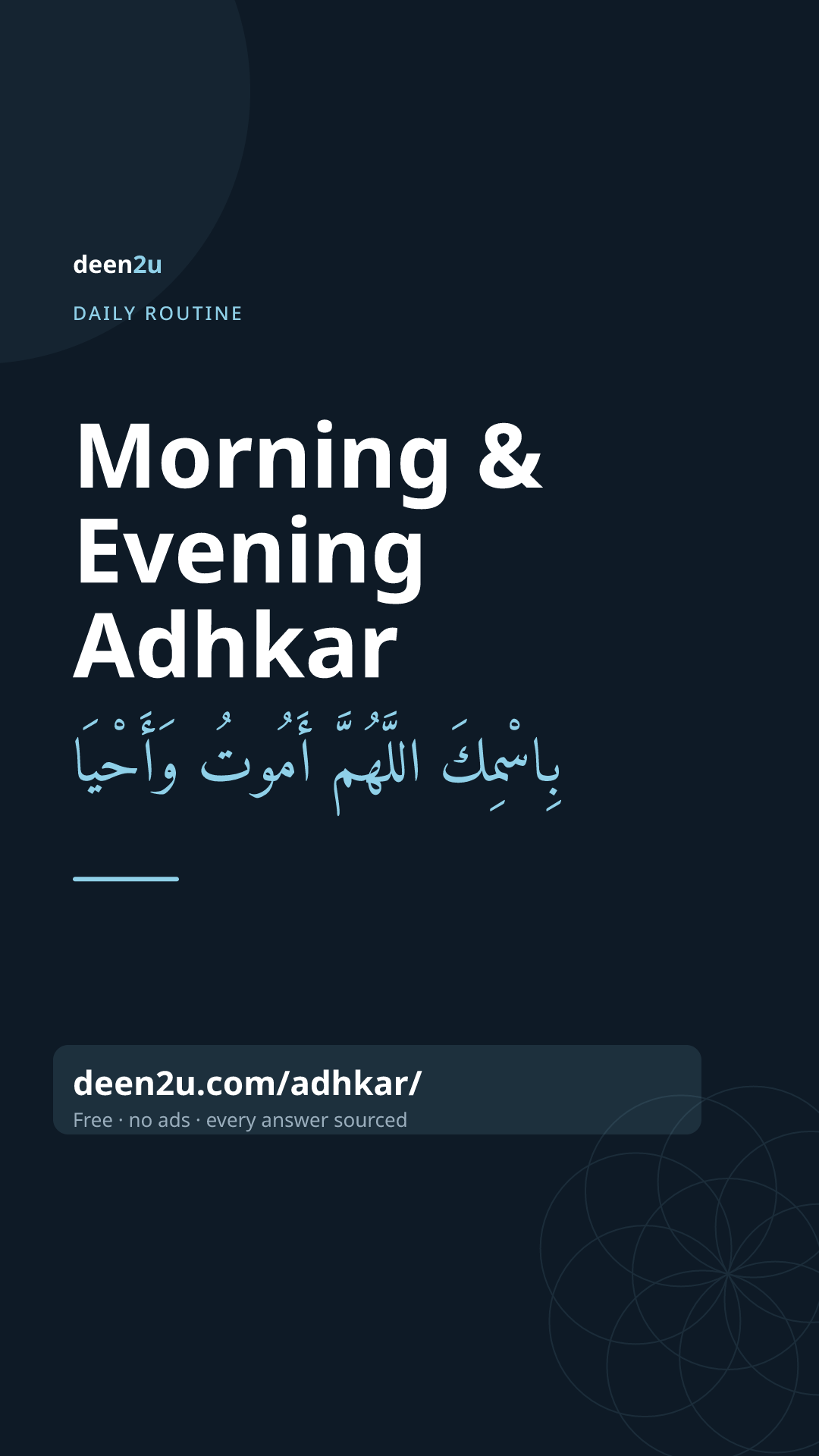
A 1080×1920 image made for phone screens — Stories, Status, Reels. It carries the heading and the link back here, so whoever you send it to can read the whole thing.
On a phone you can also long-press the poster and choose Save image. Every poster is on the poster page. Free to share — no attribution needed.