The story of Zamzam begins with the Prophet Ibrahim (peace be upon him) leaving his wife Hajar and their infant son Ismail in the barren valley of Makkah, by Allah's command — with a waterskin, a pouch of dates, and nothing else in any direction. As he walked away, he made the dua the Quran preserves:
The Well of Zamzam
A spring that broke through the desert floor for a mother and her infant son ~4,000 years ago — and has watered pilgrims at the same spot, beside the Kaaba, ever since.
WhereInside Masjid al-Haram, ~20 m east of the Kaaba
Depth~30 m, fed by an aquifer under Wadi Ibrahim
AgeDated to the era of Ibrahim & Ismail (peace be upon them)
StatusNever permanently failed — restored even after lying buried for generations
The discovery — a mother, an infant, and an empty valley
Quran — Ibrahim's dua for the valley
رَّبَّنَآ إِنِّىٓ أَسْكَنتُ مِن ذُرِّيَّتِى بِوَادٍ غَيْرِ ذِى زَرْعٍ عِندَ بَيْتِكَ ٱلْمُحَرَّمِ رَبَّنَا لِيُقِيمُوا۟ ٱلصَّلَوٰةَ فَٱجْعَلْ أَفْـِٔدَةًۭ مِّنَ ٱلنَّاسِ تَهْوِىٓ إِلَيْهِمْ وَٱرْزُقْهُم مِّنَ ٱلثَّمَرَٰتِ لَعَلَّهُمْ يَشْكُرُونَ
"Our Lord, I have settled some of my descendants in an uncultivated valley near Your sacred House, our Lord, that they may establish prayer. So make hearts among the people incline toward them and provide for them from the fruits that they might be grateful."
When the waterskin ran out and the infant Ismail cried with thirst, Hajar climbed the nearest rise — as-Safa — to look for help, saw nothing, crossed the valley to al-Marwah, and ran between the two seven times. That desperate search is re-enacted to this day by every pilgrim performing sa'i in Hajj and Umrah. On the seventh crossing, she heard a voice — and answering it, she found an angel at the place of Zamzam, digging the earth with his heel (or his wing, as the narration has it) until water flowed. The long narration in Sahih al-Bukhari records the Prophet's ﷺ affectionate comment on what she did next:
Hadith — "may Allah have mercy on the mother of Ismail"
The Prophet ﷺ said, "She started filling her water-skin with water with her hands, and the water was flowing out after she had scooped some of it… May Allah bestow Mercy on Ishmael's mother! Had she let the Zamzam (flow without trying to control it) (or had she not scooped from that water) (to fill her water-skin), Zamzam would have been a stream flowing on the surface of the earth."
The old history — settlement, loss, and rediscovery
After the discovery
Water makes a city
Birds circling the new water drew the tribe of Jurhum, travelling through the valley; they asked Hajar's permission to settle beside the well. Ismail grew up among them, married among them — and around Zamzam grew the settlement that became Makkah. When Ibrahim and Ismail later raised the walls of the Kaaba (Quran 2:127), the well and the House stood together at the centre of the valley.
The centuries between
The well is lost
The sirah and early histories record that, generations later, the well was filled in and its location forgotten — accounts attribute this to the Jurhum themselves as they were driven from Makkah, burying the well and its treasures. For a long age, Makkah drew water elsewhere while Zamzam lay hidden under the valley floor.
One generation before the Prophet ﷺ
Abd al-Muttalib digs it out
The Prophet's ﷺ grandfather Abd al-Muttalib, who held the office of watering the pilgrims (siqayah), was directed to the well's location in a dream, the sirah literature records, and excavated it with his son al-Harith — striking the old ring of the well to shouts of Quraysh claiming a share. The rediscovered Zamzam made him the most honoured man in Makkah, and the office of siqayah — serving Zamzam to the pilgrims — remained in his family. The Quran itself refers to this office when it declares that "giving water to the pilgrims" does not equal faith and striving in Allah's cause (9:19).
Zamzam in the Prophet's ﷺ life
The Prophet ﷺ was born into the family that served Zamzam, and the well runs through his story. Before the Night Journey, the angel Jibril opened his chest and washed his heart — with Zamzam water:
Hadith — washed with Zamzam before the Mi'raj
The Prophet ﷺ said, "While I was at Mecca the roof of my house was opened and Gabriel descended, opened my chest, and washed it with Zamzam water. Then he brought a golden tray full of wisdom and faith and having poured its contents into my chest, he closed it. Then he took my hand and ascended with me to the nearest heaven."
Hadith — he drank it standing
Ibn Abbas narrated that he drew Zamzam water for the Prophet ﷺ, and he drank it while standing. Scholars read this differently: some jurists (notably the Hanafis) hold it is recommended to drink Zamzam standing in emulation of him, while al-Nawawi and the Shafi'i school hold he stood only to show it is permissible — Ikrimah, in the same narration, swore he was in fact on his mount — and that sitting remains preferable even at the well. All agree drinking Zamzam standing is fully valid.
The benefits of Zamzam
The most striking testimony in the Sahih collections comes from Abu Dharr al-Ghifari's own account of how he came to Islam: arriving in Makkah alone and beaten, he lived beside the Kaaba with nothing at all — and survived on Zamzam alone for thirty days and nights, telling the Prophet ﷺ he had even gained weight on it.
Hadith — thirty days on Zamzam alone
Abu Dharr recounted that before meeting the Prophet ﷺ he remained in Makkah thirty nights and days with no food, "and I had nothing but the water of Zamzam" — yet he grew fat, and felt no hunger.
A further well-known narration — "the water of Zamzam is for whatever it is drunk for" — is recorded by Ibn Majah (Sunan Ibn Majah 3062) and others, not in Bukhari or Muslim; scholars have graded it variously — from weak to hasan — with many accepting it as sound enough to act upon. On its basis, generations of Muslims have drunk Zamzam with a specific intention — for healing, for knowledge, for a need — and made dua as they drink. What is beyond dispute from the Sahih narrations above is that it is blessed water: it sustained Abu Dharr for a month, and it was chosen to wash the heart of the Prophet ﷺ himself.
The water itself — what makes it distinctive
Zamzam rises from an aquifer beneath Wadi Ibrahim, the valley on which Masjid al-Haram stands — drawn through the alluvium (the valley's sand and gravel) and the fractured bedrock beneath it. The well itself is about 30 metres deep and a metre and a half across.
Chemically, Zamzam is hard, slightly alkaline water, noticeably richer in dissolved minerals — calcium, magnesium, and fluoride among them — than typical drinking water, which accounts for its distinct taste. It is naturally clear, without colour or smell, and the Saudi Geological Survey, which monitors the well continuously, treats it with ultraviolet light before distribution — sterilization that adds nothing to the water and changes nothing in it. Despite centuries of drawing, and pumping in the modern era measured in thousands of cubic metres a day during Hajj, the aquifer recharges and the well has never permanently failed.
The physical well — depth, rock, and recharge
Looked at as plain geology, Zamzam is a hand-dug well sunk into the floor of Wadi Ibrahim, the valley the Masjid al-Haram sits in, about 20 metres east of the Kaaba. The Saudi Geological Survey (SGS), which runs the well's technical study through its Zamzam Studies and Research Centre (ZSRC), puts its total depth at roughly 30.5 metres. The shaft passes through two very different layers: the upper portion — about the first 13 to 14 metres — cuts through the loose sand and gravel of the Wadi Ibrahim alluvium, and the lower portion runs into the hard diorite bedrock beneath the valley.
Water reaches the well from both. Some seeps in through the sand and gravel of the upper alluvium; the main flow, SGS describes, enters lower down through a thin band of permeable weathered rock and through fissures in the fractured bedrock itself — an aquifer/artesian-type system fed by rainwater that percolates down through the valley fill and by run-off from the surrounding hills. That recharge is why the well refills after heavy drawing: the water is not a sealed pocket but a working part of the valley's groundwater. SGS monitors the well digitally and continuously — water level, electrical conductivity, pH, redox potential (Eh), and temperature — so any change in the aquifer shows up quickly.
What the water is made of
Zamzam is naturally colourless and odourless, and slightly alkaline (about pH 7.9–8). Its distinctive quality is that it carries more dissolved mineral matter than ordinary drinking water. Reported figures vary between studies and sampling points, so treat the numbers as approximate; commonly cited SGS/ZSRC and peer-reviewed analyses put total dissolved solids around 800–1,000 mg/L, with some samples measured considerably higher (up to roughly 2,000 mg/L). The typical mineral profile is:
Calcium (approx)~96 mg/L
Magnesium (approx)~39 mg/L
Bicarbonate (approx)~195 mg/L
Chloride (approx)~163 mg/L
Sulphate (approx)~124 mg/L
Fluoride (approx)~0.7 ppm
The calcium, magnesium, and bicarbonate make it a hard water and give it its taste; sodium is also present (around 130 mg/L). Studies of Zamzam repeatedly note something else: samples show no algal or bacterial growth of the kind that colonises ordinary standing well water — which is part of why researchers have found the water keeps well. These are scientific findings from SGS/ZSRC and published analyses, and they stand on their own evidence, separate from the religious status the water holds.
Scientific figures above are drawn from Saudi Geological Survey / Zamzam Studies and Research Centre material and peer-reviewed hydrochemical studies of the well. Because different studies sample at different points and times, the values differ; they are given here as approximate ranges, not fixed constants.
None of this is the reason a Muslim honours Zamzam — the honour rests on revelation, not on a mineral report. But it is worth knowing that the well the Prophet ﷺ drank from is, by measurement, a real and unusual spring. And the religious testimony is explicit in its own right:
Hadith — the best water on earth
خَيْرُ مَاءٍ عَلَى وَجْهِ الْأَرْضِ مَاءُ زَمْزَمَ، فِيهِ طَعَامٌ مِنَ الطُّعْمِ، وَشِفَاءٌ مِنَ السُّقْمِ
"The best water on the face of the earth is the water of Zamzam; in it is nourishment that feeds, and healing for sickness."
Ibn Abbas · al-Tabarani, al-Mu'jam al-Kabir 11167 — graded authentic: declared sahih by Ibn Hibban, its narrators judged reliable by al-Mundhiri and al-Haythami, and graded sahih by al-Albani. Not in Bukhari or Muslim.
How to get Zamzam at the two Mosques
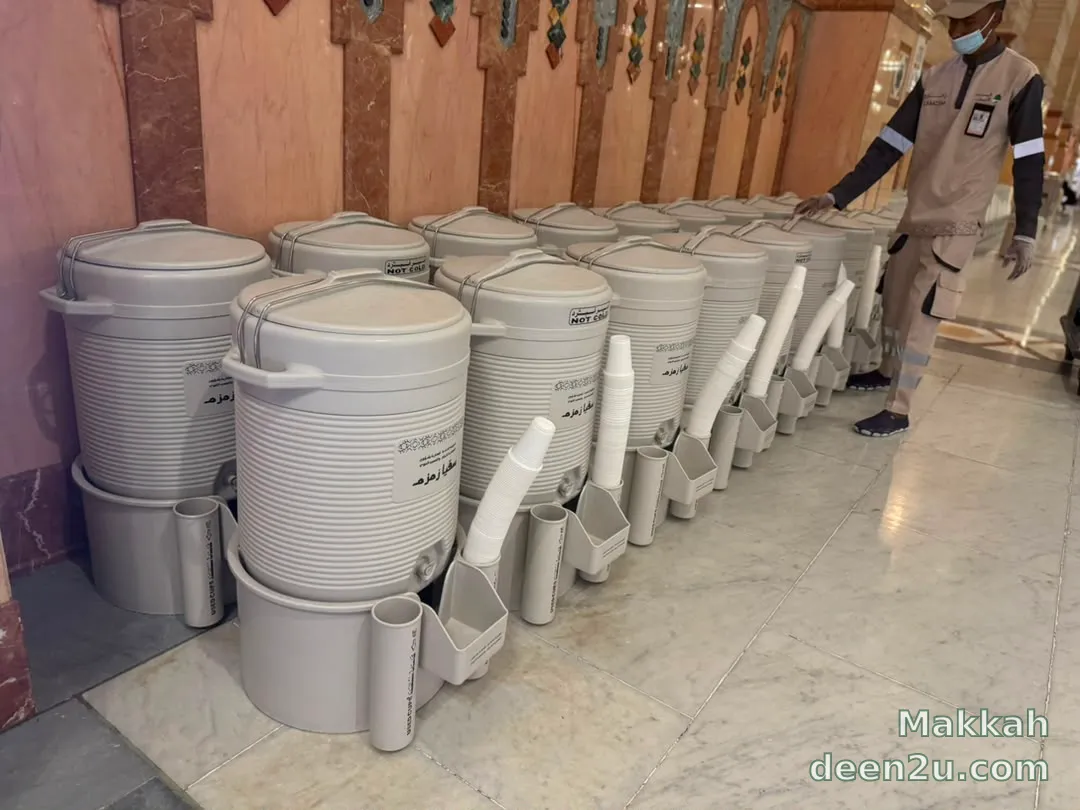
At Masjid al-Haram, you do not go to the well — the old wellhead now sits below the tawaf floor and pilgrims have no direct access to it. Instead, water is pumped up, cooled or left at room temperature, and put out in coolers and dispensers all around the mataf and across every level of the mosque. The stations are labelled — Zamzam, and usually marked hot/warm (unchilled) and cold — with cups stacked beside them, refilled around the clock. Fill a cup, face the qiblah if you can, and make dua as you drink; Zamzam is drunk for whatever it is drunk for.
At Masjid an-Nabawi in Madinah there is no Zamzam well — the water is transported from Makkah and made available the same way, from labelled coolers and dispensers throughout the mosque and its courtyards, so visitors there can drink it just as easily.
Zamzam today
The wellhead itself is no longer visible in the mosque — it sits below the tawaf area, reached by engineering access, with the water pumped to storage and cooling plants. What the pilgrim meets instead is Zamzam everywhere: thousands of dispensers and fountains throughout Masjid al-Haram and Masjid an-Nabawi in Madinah, refilled around the clock.
Since 2010, the King Abdullah bin Abdulaziz Zamzam Water Project at Kudai, a few kilometres from the Haram, has handled large-scale purification, bottling, and distribution — including the sealed containers pilgrims carry home, distributed at departure so that Zamzam reaches millions of households worldwide every year. Genuine Zamzam is not sold commercially outside this system; bottles bought from unofficial resellers abroad are frequently not Zamzam at all.
The office Abd al-Muttalib held — giving the pilgrims water — has, in effect, never lapsed: it has only grown, from a leather bucket on a rope to a water system serving many millions of pilgrims a year, from the same well Hajar dammed with her hands.
A gift for you
مَاءُ زَمْزَمَ
The Well of Zamzam
Free ebook · A gift from deen2u
Take the full guide with you
The whole story of Zamzam — from Hajar's discovery to the water science and how to drink it today — with every citation, in one PDF.
- The discovery — Hajar, Ismail, and the sa'i
- Lost and rediscovered — Jurhum to Abd al-Muttalib
- Its benefits in the Sahih collections
- The water itself — depth, minerals, and the SGS findings
- How to drink Zamzam at the two Mosques
Drawn from the Quran and the Sahih collections hosted on this site (each hadith citation verified against them); events from the sirah and early histories (Jurhum, the well's burial, Abd al-Muttalib's rediscovery) are attributed as such. Modern facts follow the published descriptions of the well's management. See also: Makkah & Masjid al-Haram · Hajj Guide · Umrah Guide · The story of Ismail.

Share this page as a poster
A 1080×1920 image made for phone screens — Stories, Status, Reels. It carries the heading and the link back here, so whoever you send it to can read the whole thing.

On a phone you can also long-press the poster and choose Save image. Every poster is on the poster page. Free to share — no attribution needed.