The Adab of Sleeping & Waking
Ending the day in remembrance and purity, and rising upon the fitrah.
This whole page, in one pocket book
Wudu before bed, the nightly recitations, the sunnah posture, and waking upon the fitrah — an A5 guide, cited to the two Sahihs.
- Sleep as an act of worship
- The nightly fortress of recitation
- The sunnah posture, and the differences
- Rising upon the fitrah
The Ruling: Sleep as an Act of Worship
Islam does not leave any part of the believer's day without guidance, and sleep — nearly a third of a person's life — is no exception. The Prophet (ﷺ) taught his companions a settled routine for retiring at night: purifying oneself, preparing the bed, reciting protective revelation, lying in a specific posture, and sealing the day with words of remembrance. These practices are, by the agreement of the scholars, Sunnah mustaḥabbah (recommended and rewarded) rather than obligatory; a person who sleeps without them has not sinned, but he has left behind great reward and lost a nightly fortress of protection.
The wisdom is unmistakable. The one who falls asleep in a state of wuḍūʾ, having sought refuge in the Words of Allah, has made his very unconsciousness an act of ʿibādah. He surrenders his soul to Allah in submission, and if death comes to him in that state — for sleep is 'the lesser death' — he departs upon īmān and the fitrah. This is why the adab of sleep is treated in the books of the Sunnah not as folk custom but as authentic prophetic teaching, transmitted with rigorous chains.
Purity and Preparing the Bed
The first sunnah of the night is to sleep in a state of purity. Al-Barāʾ ibn ʿĀzib (رضي الله عنه) reported that the Prophet (ﷺ) instructed him to perform wuḍūʾ as for prayer before lying down. Performing wuḍūʾ before sleep is recommended for everyone, and is especially emphasised for the one in a state of major impurity (janābah), as established in other authentic reports where ʿUmar asked about this and was told to perform wuḍūʾ and then sleep.
"Whenever you go to bed perform ablution like that for the prayer, lie on your right side and say, … Then if you die on that very night, you will die with faith (i.e. on the religion of Islam). Let the aforesaid words be your last utterance (before sleep)."
Sahih al-Bukhari 247Sahih
The second sunnah is to dust off the bedding before lying down. Abū Hurayra (رضي الله عنه) reported the Prophet's instruction to shake out one's bed with the inner edge of one's garment while mentioning the name of Allah, "for he does not know what came onto his bed after him." This is both a practical hygiene and a prophetic caution, and the scholars recommend doing it three times.
"When anyone of you go to bed, he should shake out his bed with the inside of his waist sheet, for he does not know what has come on to it after him"
Sahih al-Bukhari 6320Sahih
The Nightly Fortress: Recitation Before Sleep
The Prophet (ﷺ) turned the moments before sleep into a shield of revelation. Foremost among these is the recitation of the three protective sūrahs. ʿĀʾisha (رضي الله عنها) reported that each night before sleeping he would cup his hands, recite Sūrat al-Ikhlāṣ, al-Falaq and al-Nās into them, blow gently, and then wipe over as much of his body as he could reach, beginning with his head, face and the front of his body — repeating this three times.
Whenever the Prophet (ﷺ) went to bed every night, he used to cup his hands together and blow over it after reciting Surat Al-Ikhlas, Surat Al-Falaq and Surat An-Nas, and then rub his hands over whatever parts of his body he was able to rub, starting with his head, face and front of his body. He used to do that three times.
Sahih al-Bukhari 5017Sahih
Second is Āyat al-Kursī (al-Baqarah 2:255). In a well-known narration, Abū Hurayra (رضي الله عنه) was told by a thief he had caught — who turned out to be a shayṭān — that whoever recites Āyat al-Kursī when going to bed will have a guardian from Allah, and no devil will approach him until morning. When Abū Hurayra reported this, the Prophet (ﷺ) confirmed: "He told you the truth, though he is a liar."
"Whenever you go to bed, recite Ayat-al-Kursi … (If you do so), Allah will appoint a guard for you who will stay with you and no satan will come near you till morning." … The Prophet (ﷺ) said, "He really spoke the truth, although he is an absolute liar."
Sahih al-Bukhari 2311Sahih
Third is the recitation of the final two verses of Sūrat al-Baqarah (2:285–286). The Prophet (ﷺ) taught that whoever recites them at night, they will suffice him — understood by the scholars to mean they suffice him against every harm, or in place of the night prayer, or both.
مَنْ قَرَأَ بِالآيَتَيْنِ مِنْ آخِرِ سُورَةِ الْبَقَرَةِ فِي لَيْلَةٍ كَفَتَاهُ
"If somebody recited the last two Verses of Surat Al-Baqara at night, that will be sufficient for him"
Sahih al-Bukhari 5009Sahih
Finally, the day is sealed with the supplication of surrender taught in the ḥadīth of al-Barāʾ — and the Prophet (ﷺ) stressed that it be the very last speech before sleep, so that one departs into the night upon these words of tawḥīd and reliance.
اللَّهُمَّ أَسْلَمْتُ نَفْسِي إِلَيْكَ، وَفَوَّضْتُ أَمْرِي إِلَيْكَ، وَوَجَّهْتُ وَجْهِي إِلَيْكَ، وَأَلْجَأْتُ ظَهْرِي إِلَيْكَ، رَغْبَةً وَرَهْبَةً إِلَيْكَ، لَا مَلْجَأَ وَلَا مَنْجَا مِنْكَ إِلَّا إِلَيْكَ، آمَنْتُ بِكِتَابِكَ الَّذِي أَنْزَلْتَ، وَبِنَبِيِّكَ الَّذِي أَرْسَلْتَ
"O Allah! I surrender to You and entrust all my affairs to You and depend upon You for Your Blessings both with hope and fear of You. There is no fleeing from You, and there is no place of protection and safety except with You O Allah! I believe in Your Book (the Qur'an) which You have revealed and in Your Prophet (Muhammad) whom You have sent."
Sahih al-Bukhari 247 · Sahih Muslim — site reader no. 6716 (Kitāb al-Dhikr)Sahih
Posture: The Sunnah and the Points of Difference
The established Sunnah is to lie down on the right side, as commanded in the ḥadīth of al-Barāʾ above. Scholars mention several wisdoms for this, including that it is lighter on the heart and helps a person wake more readily for prayer, though the ruling stands on the text regardless of the wisdom. Placing the right hand under the right cheek is also reported in the Sunnah.
Sleeping on the back is permissible and carries no blame. It is authentically established that the Prophet (ﷺ) himself was seen lying on his back in the mosque, one leg placed over the other, so the recommendation of the right side does not render other postures forbidden.
"I saw Allah's Messenger (ﷺ) lying flat (on his back) in the mosque with one leg on the other."
Sahih al-Bukhari 475Sahih
Sleeping on the stomach (prone) is held to be disliked by most scholars. The narration usually cited for it is in the Sunan rather than in the two Ṣaḥīḥ collections, and this site's own hadith repository grades it ḍaʿīf — so it is not quoted here as evidence. The preference for the right side above rests on narrations that are ṣaḥīḥ, and that is the guidance this page stands on.
Rising Upon the Fitrah
Just as the believer surrenders his soul at night, he receives it back at dawn with gratitude. Ḥudhayfa ibn al-Yamān (رضي الله عنه) reported that when the Prophet (ﷺ) lay down to sleep he would say, "In Your name, O Allah, I die and I live," and when he awoke he would praise Allah for restoring life after this lesser death.
بِاسْمِكَ اللَّهُمَّ أَمُوتُ وَأَحْيَا
Whenever the Prophet (ﷺ) intended to go to bed, he would recite: "Bismika Allahumma amutu wa ahya (With Your name, O Allah, I die and I live)."
Sahih al-Bukhari 6324Sahih
الْحَمْدُ لِلَّهِ الَّذِي أَحْيَانَا بَعْدَ مَا أَمَاتَنَا وَإِلَيْهِ النُّشُورُ
"Al-hamdu lil-lahil-ladhi ahyana ba'da ma amatana; wa ilaihi an-nushur (All the Praises are for Allah Who has made us alive after He made us die (sleep) and unto Him is the Resurrection"
Sahih al-Bukhari 6324Sahih
In this daily cycle the believer rehearses the greatest of realities: death, and the return to Allah. He falls asleep having entrusted his soul to its Owner, protected by revelation and lying upon the Sunnah; and he rises to a new day in gratitude, upon the fitrah — the pure natural state upon which Allah created His servants. This is the fruit that the ḥadīth of al-Barāʾ promised to the one who seals his night with these words: "if you die that night, you will die upon the fitrah."
Rulings from Quran & Hadith
Evidence-based answers to common masāʾil, each with its daleel.
📖Sahih al-Bukhari & Muslim
Read the authentic collections these rulings draw on.
❓Questions & Answers
500+ answered questions across belief, worship, and life.

Share this page as a poster
A 1080×1920 image made for phone screens — Stories, Status, Reels. It carries the heading and the link back here, so whoever you send it to can read the whole thing.
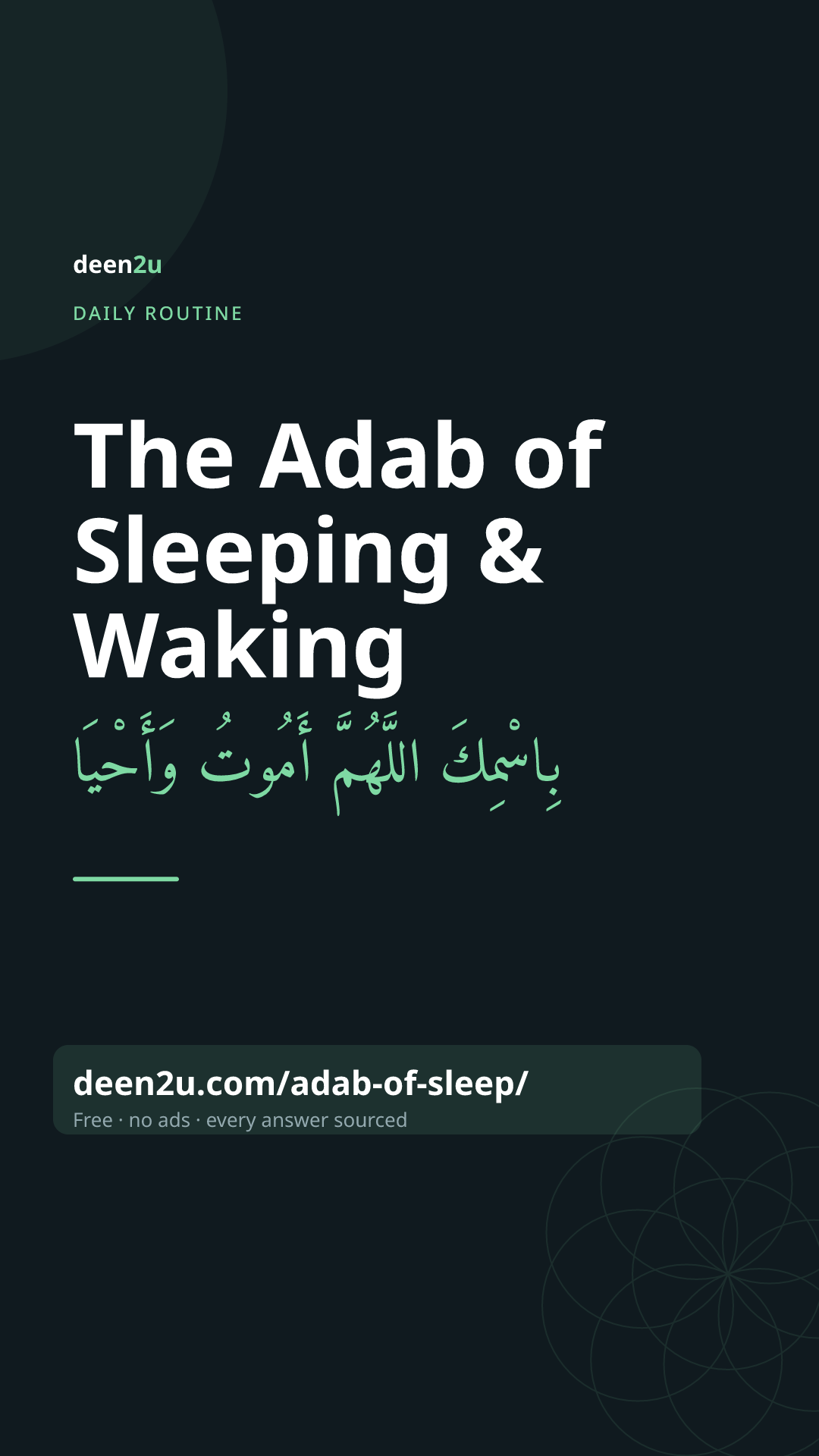
On a phone you can also long-press the poster and choose Save image. Every poster is on the poster page. Free to share — no attribution needed.